Provocateurs and Participants – a review of Acting Out: Social Experiments in Video at the ICA Boston
17.06.09
 The Institute of Contemporary Art (ICA) in Boston picks up on a curious trend in recent video art with its current exhibition, Acting Out: Social Experiments in Video, on view through October 18, 2009. The show brings together five videos by five international artists: Yael Bartana, Johanna Billing, Phil Collins, Javier Tellez, and Artur Zmijewski. Sidestepping the moral responsibility required of social scientists housed in academia, these rogue sociologists freely borrow from the methods and conventions of fiction and documentary filmmaking while deploying their own hybrid strategies. The result is a collection of conceptually complex video works whose themes, aesthetics, and politics converge and collide in interesting ways.
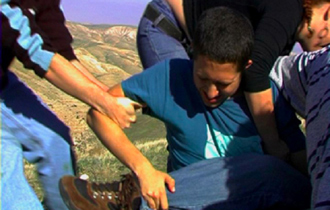
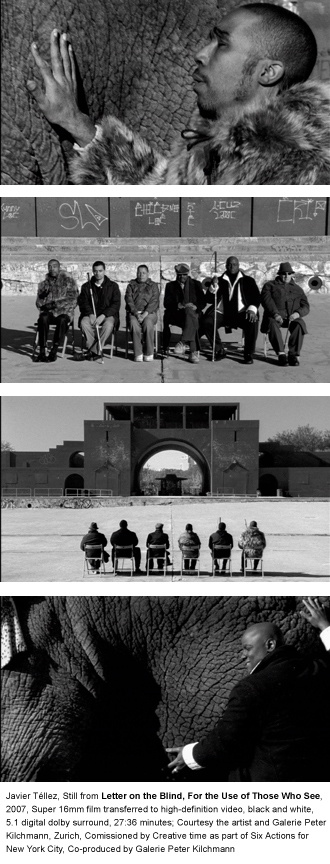
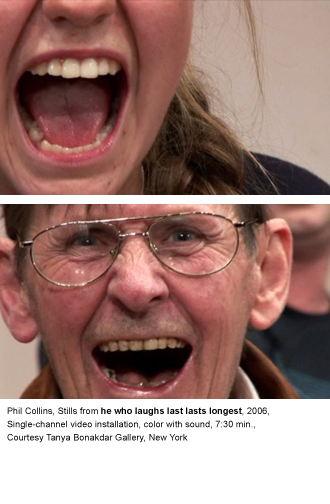
Each video centers on a social event. At the very least, something has happened as a result of a pesky artist contriving a situation involving ordinary, though carefully selected, people. Javier Tellez brings together a group of blind people and asks them all to feel an elephant. Phil Collins stages a laughing contest, complete with a cash prize for the longest laugher. Johanna Billing teaches Croatian children to sing a dreamy American pop tune. Yael Bartana asks Israeli teenagers in the Occupied Territories to play a game where some are “police” and others are “settlers.” And most provocative of all, Artur Zmijewski puts Polish nationalists, Catholics, Jews, and queers in a room with art supplies and allows them work out their ideological differences through the creation and destruction of each other’s representations.
This may sound like a lot to take in during one visit to an art museum, and it is. Visitors to the ICA should set aside a couple of hours to see the show, as two of the pieces clock in at almost 30 minutes and the remaining videos are each under ten minutes. This show is not an opportunity to escape everyday existence or wander off into abstraction; this is a chance to examine what happens when a filmmaker intervenes into reality slightly. Each work negotiates the degree to which it is staged or improvised, controlled or uncontrolled, mediated or immediate.
Cover Image: Yael Bartana, Still of Wild Seeds, 2005, Two-channel DVD projection color with sound, 6:39 min/loop, Courtesy of the artist and Annet Gelink Gallery, Amsterdam
 Acting Out focuses on the overlap of two broader preoccupations in contemporary art: a tendency toward documentary and a tendency toward art about social relationships. Numerous recent exhibitions, publications, and other forums for art world chatter demonstrate these two currents. The most notable would be The Greenroom: Reconsidering the Documentary in Contemporary Art, organized by Maria Lind at the Center for Curatorial Studies at Bard College. This three-year project is all of these things (exhibition, publication, other forum for art world chatter) and more. This past winter the Guggenheim New York presented theanyspacewhatever, an exhibition that attempted to capture the spirit of 1990s situation-based work by highlighting critic Nicolas Bourriaud’s coterie of “relational artists” such as Rirkrit Tiravanija and Philippe Parreno. The west coast was not without its own survey of feel-good art this past winter with The Art of Participation: 1950 to Now organized by Rudolf Frieling at the San Francisco Museum of Modern Art.
Participation is a central concern in all of these videos. Magical World (2005), one of Swedish artist Johanna Billing’s better-known works, involves participation from one of the more uncontrollable populations: children. However, in this piece, a group of Croatian children obediently rehearse “Magical World,” an optimistic song by American psychedelic band Rotary Connection. The lyrics, sung in English by children determined to make it through the song in this uncomfortable foreign language, speak of transformation and a brighter future, themes that resonate with the reality of Croatia’s current situation as a candidate country for the European Union. Shots of the rehearsal alternate with shots of the quiet suburb outside, making an overt association between the children and the place: like these children, Croatia is tentatively and cautiously taking steps towards defining a new national identity and assimilating with the West.
Another artist concerned with national identity, Artur Zmijewski is a Polish artist known for his ethically dubious staged social experiments that often involve physically or mentally disabled individuals. He has unsettled viewers by instigating situations involving naked people cavorting through empty gas chambers at former concentration camps, asking deaf children to sing Polish hymns, and more. On view at the ICA is one of Zmijewski’s tamer experiments, THEM (SIE) (2007). This video, the longest at almost 27 minutes, documents a multi-day encounter in which Zmijewski arranged to have four ideologically and/or culturally distinct groups of Poles engage in what he calls a “game.” Participants have been provided with large canvases and supplies with which to fashion symbols or drawings that represent their beliefs. The Catholics draw a cathedral, the Polish nationalists paint a Polish shield, the hodge-podge group of social leftists affix rainbows to the other canvases and so on. Each group takes turns vandalizing each other’s symbols until all four canvases have either gone up in flames or been thrown out the window. We witness new alliances form while older rivalries remain intact.
 British artist Phil Collins is an art world darling whose work is intentionally tethered to the entertainment industry, often mimicking and subverting the conventions of reality television. For Acting Out, the curators have selected a piece with a self-explanatory title: he who laughs last laughs longest (2006). In this work, Collins staged and taped a laughing contest, awarding a prize to a teenage girl who managed to laugh for more than an hour. The piece is edited down to a frenzied seven and a half minutes where we see contestant after contestant exhaust their abilities to guffaw; they exit the stage crying and coughing.
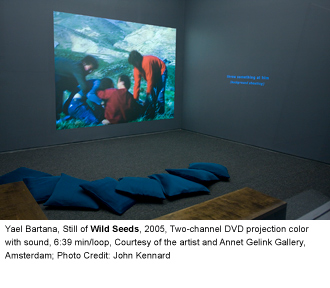
Yael Bartana is an Israeli artist who recently had her first major American solo exhibition at PS1 in New York. Wild Seeds (2005) was on view at PS1 in New York City, and it is currently at the ICA Boston. For this piece, Bartana rounded up a group of young Israeli leftist activists to play a very physical game of “police” and “settlers.” Set on a hill in the Occupied Territories, this two channel video projects one image of the young people as they wrestle and giggle in a pile. The subtitles are projected on the adjacent wall, phrases such as “Go back where you came from!”
Venezuelan-born, New York-based artist Javier Tellez premiered Letter on the Blind for the Use of Those Who See (2007) at the 2008 Whitney Biennial. Shot in a large, unused swimming pool in Brooklyn’s McCarren Park, this film is an interpretation of an ancient Indian parable “Six Blind Men and an Elephant.” Tellez gathered six blind people together and asked each to take a turn touching, rubbing, patting and talking to a docile elephant brought in for the film. Tellez structures this piece like a conventional documentary, with establishing shots of the elephant and the blind people entering the deserted pool, and interviews with each participant. The film was shot on black and white 16mm film and transferred to high definition video, allowing for highly detailed images. Tellez’s piece successfully communicates a sense of the tactile experience the blind participants may have had by including many lingering close-ups of the elephant’s leathery skin and fine, soft hairs.
 The show’s installation is interesting with its innovative design that merges the openness of a gallery space with the dark quiet of a theater space. Each video occupies its own room, although the Zmijewski piece is installed in the main room that leads to each of these smaller rooms. The entryways to each room have rectangular windows that allow you to peek at the large cinematic projections inside, thus providing a sense of the layout of the space and the content of the show as a whole.
This small exhibition has not solved the problem of how to exhibit video work so that the audio does not carry over to other parts of a gallery. The sound from the Collins piece dominates the environment, but this encourages active listening; you need to tune in and focus on one video at a time. Because the Zmijewski piece is located in the main room, it takes on a special significance, as though it is emblematic or representative of the entire exhibition. This is unfortunate because it is one of the longest pieces and it has the most involved narrative. It would be better served in a more private space, away from distractions like unsuspecting tourists who happen upon the exhibition and suddenly find themselves disoriented in the darkness.
An exhibition of video art focused on a particular process, in this case the “social experiment,” is unusual, as most rely upon geography, time period, or the personal identities of the makers as organizing principles. One of the main contributions of the show is that it focuses attention on this one small node in the cultural landscape. My understanding of the practice of “acting out” is that it is a kind of anti-social behavior, a way to process repressed memories or desires through unconscious or conscious actions. The videos in this exhibition do not seem overly concerned with psychoanalytic understandings of their subjects. Rather, it seems that the curator means to suggest that this genre – the social experiment in video – is a kind of acting out. It acts out against the institutions of mainstream television, academic social science, and rigorous categories of documentary and fiction. The ICA Boston has captured an interesting moment in video art, so check out Acting Out if you are in New England this summer.
