A Real Boy At Last: A Discussion with Artist Oscar B. De Alessi On Youth Culture, Representation, and Suicide
02.05.10
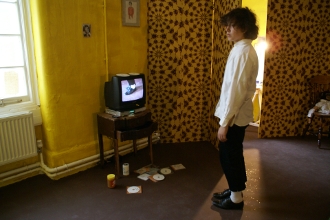 I knew Oscar before I knew O.B. de Alessi. Oscar doesn’t exist. Or maybe it’s the other way around. That’s one of the many aspects of genius to be found in de Alessi’s work: she morphs into her art in such a way that you can no longer find the seams. Her performance art is an act of continuity, one where the artist is no longer satisfied by conveying an idea through her art but, instead, chooses to become the artwork and convey the message through herself. Fascinated by the concept of dandyism and, yet as a woman, unable, according to Baudelaire, to actually become one, de Alessi has become a dandy by proxy. Oscar is a dandy and, therefore, Alessi is as well. The ideas of dandyism and libertinage have compelled me for quite some time and I have sought out portrayals of them incessantly. And de Alessi’s work is certainly a major discovery. It’s too bad Baudelaire is long gone or else we could have introduced him to our very first female dandy.
I have said numerous times to different people that no one can explain this work better than de Alessi herself. Of course, Oscar could probably do a fine job of it as well.
Your bio says that your work “has a very strong theatrical element that [you] consider related to [your] interest in literature.” Are there any particular pieces of literature or schools of literature that have had a particularly strong influence on your work?
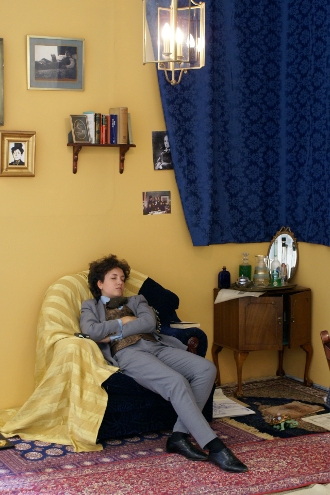
I have been very much influenced by 19th century literature, especially by authors such as Oscar Wilde, J.K. Huysmans, Charles Baudelaire and Arthur Rimbaud. Some of my works are actually directly related to these figures. In the performance/installation ‘Oscar’ for example I impersonated a stereotype of the ‘dandy’, albeit immediately subverted by the fact that I am a woman, and the ‘dandy’ cannot be a woman (see Baudelaire). But this character was created with a mixture of many characters, both fictional and non-fictional, such as, Oscar Wilde, of course, and [Huysman’s character] Des Esseintes. I actually followed step by step the description of Des Esseintes’ studio in Against Nature to create the environment.
I have also always been interested in merging different spheres of culture, such as literature and history with popular culture. In the last large scale installation I did Written in The Stars, for example, I used references to both pop music and culture (in this case, mainly Michael Jackson) and literature (J.M. Barrie, Lewis Carroll, etc..)
How do you choose these characters? In other words, are the facets of their personality determined by what you want to do artistically? Or visa versa?
The characters I have chosen so far all come from an attempt to exteriorize what I perceive as being my ‘inner ego’ (or egos). The fulcrum of my work, especially of the performative kind, is the role-playing I used to do as a kid. I consider those moments as the purest, most honest ones in my life, as I was able to completely express my self through the impersonation of my own idea of what a character would have been like. This is what I am trying to recreate in my performances. I also think the element of ‘failure’ is a very important one in my work, because I am already aware that I will never be able to exactly recreate what I used to feel as a kid. So my work is always already impossibly striving to achieve something that is unachievable as a physical object/situation.
Also, I am very much interested in the idea of levels of fiction, by which I mean that one can talk about real life experiences through the use of a universally recognizable (or nearly so) icon.
In Written in the Stars, for instance, the subject of the work seemed immediately to be ‘Michael Jackson’. But, in fact, I wasn’t talking about him at all. I was rather talking about myself, what I experienced through his image/work as a kid and my own interpretation of him. I would therefore say that all these works could be described as “self-portraits with a mask on.”
 Being interested in literature, I’m curious to know how you feel about the contradictions between visual art and literature. For example, whereas a novel, once published, is, to some extent, permanent, an art exhibit is dismantled after the show. Does this semi-inevitable ‘disappearing act’ serve your art or hinder it in any way
I think ‘disappearing act’ is a very interesting way of describing my work and, more in general, performance art. Most of my work contains some kind of narrative, and therefore implies not only a moment of ‘happening’ in the present, but also a past cause and a future consequence. The relationship –between a factual time in which the act takes place and a fictional time (and place) — puts the audience in a very interesting position. This is why I so often compare my work to literature. One finds oneself suspended between two different places and times. In what [psychoanalyst Donald] Winnicott would describe as a third space, an area where fiction and reality collide and form an ‘other’ reality. This particular place and time is temporary, changeable. Its physical presence does disappear, but the memory of it persists in the spectator’s mind and becomes something else.
Your work deals with ‘play-acting’, a universal element of childhood. You’re also a friend and fan of Dennis Cooper. Dennis’s work, to some extent, attempts to capture emotions common to youth. Do you feel any particular affinity to his work in this regard? What other art forms (particularly music since you’ve mentioned Michael Jackson) do you feel deal with similar themes? Are they successful in their attempts? I also see thematic similarities between your work and the work of Aspen Michael Taylor (Kiddiepunk). Do you feel as though you and he, though your art is fundamentally different, share some of the same goals regarding childhood?
I surely find a common ground with Dennis’s work when it comes to unfulfilled desire, fantasizing, and identification with fictional characters. Dennis’s characters are very dramatic. Children and teenagers are very dramatic, the emotions they experience are at their purest form because they have no relation to experience. To desire ‘something’ means to desire ‘everything’, to desire, in fact ‘desire’ itself, the result of which is boredom.
I have been looking into dramatic representation of these feelings, especially, through the use of mass media such as the internet and pop music. I am very interested in the way personal experience (inner ego) can be experienced or acknowledged through popular icons. The word ‘icon’ means simply ‘image’, but it is a particular kind of image, one that always stands for something else, it’s a signifier of an idea or value that tends toward universality. When I think of this type of image, I automatically think about masks and theatre. Theatre surely deals with these themes — it is about role-playing and the representation of feelings and moods through fictional characters. Of course, while pop music is conceived to be understandable and reachable for everybody, theatre is not. This is why I am particularly interested in the use of theatricality within mass mediated culture.
 Thinking about what I have just said in relation to your next question, whether there are similarities between Aspen Michael Taylor’s work and mine, I would say there are common themes, but they are dealt with in a very different way. I think that Michael’s work is about feelings and moods. He does not want to explain them or historicize them. Most of his works are, like feelings, removed from a specific time and place. They are also removed from narrative, even though I should add that his work is moving towards a more narrative approach. My work, on the other hand, uses cultural and popular references in a direct way. Feelings are summoned through an object or an image, like in a ritual, while Michael brings to light feelings that seemed to be there already. He shows the invisible, the spirit. I try to show how the surface can produce meaning.
This said, I think one interest that we share is something that has to do with myths and the way a deeper, perhaps primordial, meaning is always already present. But, while Michael ‘unveils’ objects and people, I ‘make them up’.
Speaking of ‘play-acting’: While reading about your art in essays you provided, I was made aware of the fact that, even as an adult, people continue to don particular roles. I, personally, almost always relate to literary figures. I feel the need in such instances, to construct my atmosphere and living space around what I want others to think of me. You mention above that you reconstructed the dandyish character Des Esseintes’s studio in order to create a particular environment. What do you think is the importance of an environment (and people’s perceptions of this environment) to your work? You also mention an element of ‘failure’ that exists in your art due to the impossibility of ever fully recreating the innocence of play-acting for a child. How is this failure represented in your art? What do you feel is the reason for such a failure? In other words, what makes adults incapable of fully recapturing the feelings they experienced as a child?
Play-acting is about existing in an alternative space and time as someone else. It allows you to effectively ‘travel’ without physically moving, and to even mutate your body, become, for instance, an animal or acquire supernatural powers. It is fantasy work, but it does ‘happen’. As we grow up, we keep memories of those moments, long for them, even dream about them. There is no difference between that kind of experience and ‘real life’ experience. The power of play-acting lies therefore in the possibility of seeing the world, and yourself, from a different perspective. It teaches you things about yourself and about others. Play-acting is an immersive experience, nothing around you stays the same, every single object acquires a different meaning and ‘flavour’. The need to create environments in my work stems from the attempt to make others give up their everyday roles at least for a few minutes. I try to displace, to confuse the viewer by throwing them in a space and time they quickly have to come to terms with. By making the spectator feel like she ‘does not know what’s going on’, I ask them to surrender their identity and take up a new one.
 The element of failure exists not only inherently in the themes my work is based on (longing, anxiety over self-representation, striving to obtain something that is beyond one’s possibilities, such as becoming a ‘super-hero’, attempting to defeat death and decay), but also in the way my work is made and in the final visual result. My work does not look, for instance, completely ‘finished’ or ‘polished up’. I am just not interested in finished-ness. I’d rather keep working on an idea that I know to be impossible to achieve from the beginning. The term ‘failure’ is obviously always very relative, but I think the awareness of the impossibility of actually achieving one’s dreams (and I am talking about dreams without compromises, such as being able to fly) makes the work rather dark or melancholic in some way. I am interested in representing desires or ideas in the most direct and honest way, with as little mediation as possible. These representations will, therefore, look like something unstable, slightly clumsy perhaps, almost pathetic in their absurdity. To me, there’s nothing wrong in having doubts, making mistakes and contradicting oneself.
I find your discussion of the ‘representation and idea of death, the death drive, and the thought of suicide’ to be very intriguing, so my question is: How is the idea of the death drive and contemplation of suicide manifested in the character of Oscar? And, in particular, what, if any, relationship is there between this contemplation of suicide and the idea of the ‘dandy’? And, in relation to your work, what are your thoughts on teen suicide and the romanticizing of death? Is this a version of ‘play-acting’?
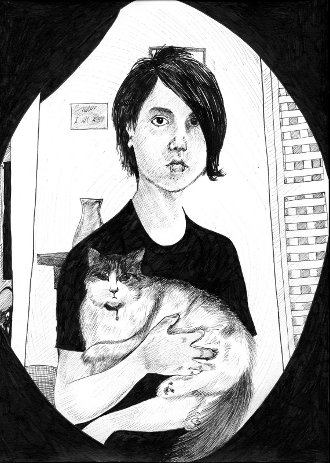
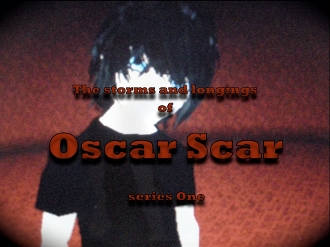
Four of the main characters ‘Oscar Scar’ is based on are Hamlet, Werther, Peter Pan, and an existing cat called, well, Oscar. Hamlet doesn’t commit suicide directly, but he ponders, hesitates, postpones until he finally dies. The thought of suicide is there to clarify the mind of someone who cannot decide who they are. Oscar, in his state of eternal adolescent, is one of those individuals or, rather, represents them all. And, like many people of that age, he needs to represent death and suicide, and do so in an extravagant, explicit, Romanticized way, because, like love, death is present, it is sure, and yet it is unknowable. This is also why Oscar Scar is represented as being into Black Metal. I think there is something magical in the act of representing such a strong statement in such a direct, almost obvious, way. In J.M. Barrie’s Peter Pan, Peter is at some point faced by death. He prepares himself for it, and “with a drum beating in his heart as if he were a real boy at last”, Peter says “to die will be an awfully big adventure.”
Oscar knows he is not a real boy. He is not ‘real’, and yet he is fed by real life experiences (mainly mine). But he lives in a world where everything becomes symbolic, and death represents his (my) will to freeze in an eternally youthful existence.
The Oscar Scar’s life exists in a virtual world (even when he is physically present, his world is always to be considered as a parallel one, which people can enter or observe from the outside) or, I should say, many virtual worlds. Therefore, Oscar can be Werther on his blog, but he can also be a cat somewhere else, all at the same time. I should briefly talk about who this cat is, I suppose. This cat is currently living in a hospital in Rhode Island. The cat is said to be able to predict people’s death.
In my work, it appears at the end of the fifth, and last, so far, chapter of the comic “Becoming Oscar Scar.” Since the story describes Oscar transition from being a 19th century ‘dandy’ to being a teen boy in the present, the appearance of the cat in the last chapter seems to suggest that Oscar (the boy) has either become the cat, or has died.
I am currently working on another comic written by writer Nick Brook whose main character is Oscar the cat. The story, which is completely detached from that of Oscar the boy, focuses on the cat’s function as an angel of death, but also a shepherd of souls, which interestingly relates its character to that of the original Peter Pan (as described in Peter Pan in Kensington Gardens).
Boredom could be described as a ‘desire for desire’. It happens, in short, when desire becomes its own object. The ‘dandy’, especially if considering figures such as Huysman’s Des Esseintes, has made of boredom, his own life. The idea of death is inherent in that of immobility, unproductiveness, lack of communication with the outside world, and the attempt to make of oneself a ‘superhuman’ or, anyway, someone that is beyond human necessities and functions, such as food and sex. Dandyism then becomes similar to a religion in which the individual is both the worshipper and the idol. I think I find the stereotype of the dandy interesting because, while not representing ‘the masculine’ (the dandy is sensitive, fragile, melancholic, ambiguous, hysterical, dreamy, etc…), it is opposite to the ‘woman’. The ‘woman’ (again as a stereotype) represents for the dandy exactly what he is trying to escape from: nature, carnality, physical need, expression of emotions. In short, life, I would say.
My work is neither a critique nor a compliment to the ‘dandy’ stereotype. It just attempts to revisit it in a different key. It is ironic but not cynical, camp but not necessarily ‘queer’.
I think that romanticized death is exactly like romanticized love. It is an idea that appears everywhere, it is a constant and resonant theme. When you’re a kid, if you’re lucky enough not to have gone through real death threats, such as war, you base your ideas not on life experiences, but on the cultural references you are fed. Your emotions are mediated by external images you have chosen to represent yourself. And, more often than not, these chosen figures have something heroic and exciting in them. They fight, fly, run, love passionate loves, kill, die. Often, they are doomed figures, and surely, the reasons why they do what they do is not strict practicality like, for instance, having to go to work to pay their rent. I think the realm of the imaginary and the mythological where all these actions take place in a romanticized way is a very important place to be as a kid. It is about strong emotions, above all.
Suicide happens for a number of different reasons, each one of them being a single case that depends on many different factors. I don’t really want to generalize here. What I do think is that it is rather ridiculous to blame the representation of death in popular culture for suicide. First of all, because there have always been representations of death, and kids are constantly exposed to death in literature classes (just think of Greek tragedies, Shakespeare, epic literature and so on). And secondly, because I actually believe that to represent death helps you to give it a face and share it, and, therefore, in some way exorcise it. Popular subcultures, in this sense, really do become like religions. They help you make sense of yourself and life, even if temporarily, perhaps.
Accompanying Images:
p. 1 from Written in the Stars, performance and site-specific installation, 2009
p. 2 from Becoming Oscar Scar, graphic novel, 2009
p. 3 still from The Storms and Longings of Oscar Scar, video DVD, 2009
p. 4 from Oscar, performance and site-specific installation, 2008.
p. 5 from Better By You Better Than Me, Performance and video, Guest Projects Space, London, 2010
“Selected Works of Oscar B” at Dennis Cooper’s blog
__________________________________________________________________________
Related Articles from The Fanzine:
Jesse Hudson on Kevin Killian’s Impossible Princess
