Talk Show 14 with Elisa Albert, Anita Diamant, Michael Lowenthal & Jim Shepard
02.06.08
 Elisa Albert is the author of the short story collection How This Night is Different. She is an adjunct assistant professor of creative writing at Columbia University and an editor at large of Jewcy.com. Free Press/Simon & Schuster have just published her first novel, The Book of Dahlia. Visit Elisa at www.elisaalbert.com.
Anita Diamant’s first work of fiction, The Red Tent was published in 1997 and was awarded the 2001 Booksense Book of the Year. She is the author of two other novels, Good Harbor , and The Last Days of Dogtown, six non-fiction guides to contemporary Jewish life and Pitching My Tent, a collection of personal essays. Visit Anita at www.anitadiamant.com.
Michael Lowenthal is the author of three novels: Charity Girl, Avoidance, and The Same Embrace. His stories have been widely anthologized, most recently in Best New American Voices 2005 and collections from Tin House and Nerve.com. The recipient of fellowships from the MacDowell Colony, the Bread Loaf and Wesleyan writers’ conferences, and the Massachusetts Cultural Council, Lowenthal teaches creative writing in the low-residency MFA program at Lesley University. He also serves on the Executive Board of the literary human rights organization PEN New England. For more information, please visit www.MichaelLowenthal.com.
Jim Shepard is the author of six novels and three collections of stories, most recently, Like You’d Understand Anyway, which was a finalist for the National Book Award. He teaches at Williams College in Williamstown, Massachusetts.
––Name one of the greatest traumas of your generation.
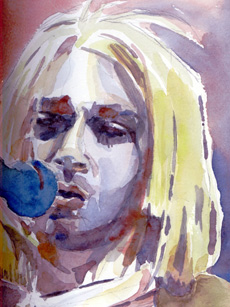
Albert: By my “generation”, I assume you mean people born in the summer of 1978, right? Okay, so, I have to say that the school year of 1993/4 was pretty intensely traumatic for us. Within the span of some measely months, River Phoenix OD’d, Kurt Cobain committed suicide, and OJ (allegedly or whatever) killed his wife and a random friend of hers. This trio of mortality insanity was a lot at once, and included some powerful players in our collective cultural consciousness. It also sort of thrust the fact of violent, untimely death right up under our cushy, adolescent little noses. (That or, I suppose, George W. Bush stealing the f**king election in 2000. But I still can’t deal with that one, so never mind.)
Diamant: The AIDS crisis of the 1980s.
Lowenthal: So many traumas, so little time! September 11 is the obvious one, but too much has probably been said about that already (see: Rudy Giuliani campaign, 2007). On the other end of the spectrum, the ball rolling through Bill Buckner’s legs in the 1986 World Series caused its own kind of generational PTSD, at least here in Red Sox Nation. But the one I’m going to go with is George Bush’s reelection in 2004. His initial “election” was trauma enough—forcing us to let go of any notion that the Supreme Court operates above political partisanship, etc., etc.—but in the wake of this utter disaster there was a sense that perhaps it was a fluke; that Bush’s “Hey, let’s all share some Beer Nuts” publicity machine was slick enough to have fooled America once, but not twice; and that millions of Americans, stung by Bush’s illegal and immoral reign, would be more energized than ever to depose him. And so, when he managed to win AGAIN, and this time probably (though perhaps not) legitimately, even after having caused the deaths of so many Americans and Iraqis, even after having ruined America’s standing in the international community, and even running against a legitimate war hero . . . well, this was just the definitive snuffing of all of our generations hopes.
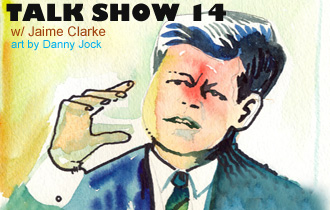
Shepard: I’m not sure whether it’s my generation or not, but I still viscerally remember coming home from first grade to discover my father standing in the driveway, waving his arms to me and shouting to me before I even got into the house that President Kennedy had been shot. His shouting and arm-waving—the fact that he was evidently so unmoored by the event––floored me, and made me feel somewhat the way he did: as though someone had just pulled the rug out from under everything we believed in. So somebody—or the world—could just do *that*? Apparently they could. It was a lesson we’d have reinforced throughout the Sixties.
 ––What were you doing when this drama occurred?
Albert: Variously nodding off in some obnoxious Advanced Placement high school course, cutting myself in the bathroom while my mother pounded on my locked bedroom door demanding that I turn down the Smashing Pumpkins, and using my ’84 Volvo station wagon like a bumper car.
Diamant: I was working as a freelance journalist around Boston as the disease was slowly recognized, its cause identified, and then ravaged the gay community. As a straight woman, I was on the fringes of the disaster in many ways, but I wrote several stories about its devastation and how the local medical and gay communities rallied and responded. I also had a few gay friends, who were closer to the epicenter of the disaster. Eventually, it “came home” as I lost a colleague, and then a cousin.
Lowenthal: I had spent all of Election Day with my friend Jennifer Haigh, up in New Hampshire, at Kerry headquarters, phoning Democratic voters and making sure they were going to get to the polls. It felt good to be doing something concrete to help the cause, and as the party-insider info started rolling in, it seemed clear that we were going to win. We were so exhilarated! (And, in fact, New Hampshire was the only state in the country that voted for Bush in 2000 and then voted for Kerry in 2004.) At the end of the day we came home to Boston and hosted a victory party. Except that by that evening the early exit poll data had been discredited and it seemed Bush might have won. The Kerry/Edwards team had been planning their own official victory celebration downtown, in Copley Square. I couldn’t persuade anyone to go with me, so I went alone. It was cold and rainy. CNN was playing on a huge Jumbotron. Ohio was going for Bush, then for Kerry, then for Bush. In the wee hours, John Edwards came out onto the stage and told us, in the most hopeless voice I’ve ever heard, not to lose hope.
Shepard: See above.
––How did those around you react this trauma?
Albert: Respectively: by blaming the victim, blaming the victim, and blaming the victim.
Diamant: It was a very bifurcated response: total mobilization or full denial. The fact that then-president Reagan did not utter the word “AIDS” until late into his second term was the most vivid demonstration of the way that the political establishment and lots of other people wanted to pretend it wasn’t happening; that we weren’t losing a generation of smart, creative, wonderful people. On the other hand, the gay community grew up as a response to AIDS; gay men and lesbians of my generation took action, struggled, fought, coalesced, took care of their own, built institutions and organizations, and transformed the cultural landscape forever. They fought the war on AIDS. They were helped and supported by doctors, nurses, social workers, and volunteers I met while working as a reporter; those people threw themselves into the fight against the disease—both as clinicians and as researchers and as human beings—with total dedication and passion.
In the end, the AIDS crisis changed the way that vast segments of the straight community understood homosexuality and gay people. It was very personal, finally. The losses of brothers and sisters, children and friends helped turned the tide against homophobia, person by person, family by family. NOT TO SAY IT’S OVER. Matthew Shepard was murdered long after the disease stopped making headlines in America, long after AIDS became a chronic rather than a fatal disease for many. But attitudes were changed as a result of the public and proud acknowledgement of the presence of gay people everywhere in our culture and in our families.
 Lowenthal: The crowd in Copley Square was so stunned and sad. It was as though our optimism was a beautiful creature that had been amputated at the knees. Against all our better judgment during the dark times since 2000 and Bush’s stolen election, we had kept some faith in “the system” and its ability to correct itself, in truth as opposed to truthiness, in the “reality-based community.” But now we seemed irreparably detached from our country and its people (and it was weird to have this happen in real time, in the rain, with John Edwards less than fifty feet away, seeming so small up there on that stage). I know many folks who gave up entirely on politics after this, who refused to read the newspapers or to vote again. Which means that Bush and his team scored their ultimate victory, far beyond this specific election.
Shepard: My family (mother, father, older brother, and me) spent the rest of the day and the days following around the television, seeing the same information over and over, until *that* changed dramatically, too, when Lee Harvey Oswald was himself assassinated in custody. Throughout all of that, the family’s inability to look away, to go on to something else: that also seemed undeniable evidence that this was a massively important event.
––Which traumas for other generations, past and present, do you imagine are the equivalent?
Albert: I don’t think generational trauma, by its very nature, can ever be equivalent to anything but itself. It’d be ridiculous to bring up Pearl Harbor or the assassination of JFK here, would it not? But I’d be curious to talk to someone a decade younger than myself about Britney’s head-shaving and etc.
Diamant: I wouldn’t want to compare this to wartime traumas, or even to other epidemics, since AIDS was/is such a loaded cultural phenomenon as well as a medical crisis. I leave it to history and historians to determine whether it was truly a “unique” moment.
Lowenthal: I don’t know. I think of the challenges to progressive Americans’ faith during the 60s, when so many bright and shining leaders were assassinated. I know these events must have been unbearably hope-crushing. But it was possible then, I imagine, to believe (and perhaps rightly) that the killings were the acts of deranged individuals, and didn’t represent the will of the mainstream. Indeed, in some cases the losses may have galvanized the majority to further progressive action. In 2004, by contrast, nobody was killed, but the loss of faith was severe because it became clearer than ever that the majority of Americans—tens of millions of my countrymen and -women—was committed to taking action AGAINST progressive values. The majority (or, the majority of those who participate in the political process) seems to be small-minded, selfish, and fundamentally skeptical of the idea that government can be a force for good.
Shepard: Who knows, really? The intensities of traumas I’d assume have everything to do with individual idiosyncracies. I’m sure I had some classmates who were more or less unfazed by the Kennedy assassination. I don’t remember, now.
 ––How has your relationship to the trauma changed over the years?
Albert: Now I understand that women are routinely and commonly murdered by their boyfriends/ex-boyfriends/husbands/ex-husbands, so that’s not a shocker anymore. And as for River and Cobain, they’ve both been deified pretty thoroughly, so it’s hard to imagine them living on as mere mortals. And since I’m an adult now, these tabloid horrors can seem a mite trivial. Compared to, say, GWB’s stealing the f**king election. For example.
Diamant: “Crisis mode” is long past in North America. I have another cousin who is HIV-positive and has been for many years; he is healthy and thriving. The AIDS crisis rages in Africa and other parts of the world; when I read about it, I recall the sense of despair engendered by all of those death announcements in the newspaper; the ones that you had to interpret to figure out if they were from AIDS or not, and then, later, the ones that clearly stated HIV/AIDS as the cause of death. Every now and then I experience a sort of “phantom limb” phenomenon, when a name is mentioned—a choreographer, a writer, a composer, a friend’s deceased lover: they should be here and they are not. We have no idea, really, what was lost. What might have been saved had the response been quicker, more compassionate, more appropriate to the threat. I suppose I’m still angry about that. But I am also grateful for and proud of the courage and conviction of everyone—gay and straight—who fought so hard to save lives and to challenge misunderstanding of and bigotry based on sexual identity.
Lowenthal: I remain battered, and wonder if my faith will ever be restored. In 2000, I allowed myself to believe that Bush’s election was a fluke. Now, after having lived through 2004, I think I’ll consider a Democratic victory (if there is one) to be the fluke. I’ll accept it, and happily, but I won’t make the mistake of thinking it betokens any kind of turn toward the better by, or smartening up of, my fellow Americans. I’ve become entrenched in my alienation. I recently applied for German citizenship, wanting an “out” in case our country continues to devolve. How ironic that Germany, the country from which my grandparents fled in 1939 (and from which other relatives were unable to flee), looms now as a possible haven.
Shepard: I’m certainly, for better and for worse, now more likely to expect it.
Jaime Clarke is the author of the novel WE’RE SO FAMOUS, editor of DON’T YOU FORGET ABOUT ME: CONTEMPORARY WRITERS ON THE FILMS OF JOHN HUGHES, and co-founder of POST ROAD, a national literary magazine based out of New York and Boston.
