Talk Show #16 with Elizabeth Crane, Michael Dahlie, Tony D’ Souza, and Salvatore Scibona
12.08.08
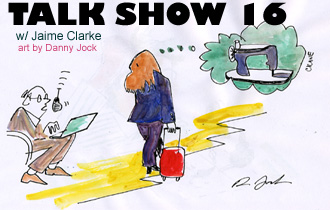
Elizabeth Crane is the author of two collections of short stories: When the Messenger is Hot and All This Heavenly Glory. Her latest collection, You Must Be This Happy to Enter, is just out from Punk Planet Books. Her work has also been featured in publications including Washington Square, New York Stories, Sycamore Review, Florida Review, Eclipse, Bridge, Sonora Review, the Chicago Reader, the Believer, and McSweeney’s Future Dictionary of America. Her stories have been adapted for stage and screen. She received the Chicago Public Library 21st Century Award in October 2003. Crane lives in Chicago with her husband and teaches writing at The University of Chicago and the School of the Art Institute. Visit Elizabeth at www.elizabethcrane.com.
Michael Dahlie is the author of the novel A Gentleman’s Guide to Graceful Living. His short stories have appeared in Ploughshares, The Kenyon Review, and Mississippi Review. He lives in New York City.
Tony D’Souza has contributed fiction and essays to The New Yorker, Playboy, Esquire, Salon, Outside, The O. Henry Awards, The Literary Review, McSweeney’s, Tin House and elsewhere. His feature on the Eric Volz murder trial has been nominated for a National Magazine Award, and Tony has appeared on The Today Show, Dateline, NPR and the BBC talking about the case. Tony’s first novel Whiteman received the Sue Kaufman First Fiction Prize from the American Academy of Arts and Letters, Best First Fiction from Poets & Writers Magazine, the Florida Gold Medal for Fiction, and was a finalist for the LA Times First Fiction Prize and the New York Public Library’s Young Lions Award. Tony’s second novel The Konkans is a tale of desire, adultery, corruption and fear set in Chicago and on India’s Konkan Coast. Visit Tony at www.tonydsouza.com.
Salvatore Scibona’s first novel, The End, will be published by Graywolf Press in 2008. His short fiction has appeared in The Threepenny Review, Best New American Voices 2004, The Pushcart Prize XXV, and The Pushcart Book of Short Stories. A former Fulbright Fellow and a graduate of St. John’s College and the Iowa Writers’ Workshop, he has received grants and fellowships from the estate of James Michener, the Massachusetts Cultural Council, the MacDowell Colony, Yaddo, and the Fine Arts Work Center in Provincetown. He is currently the coordinator of the writing fellowship at the Fine Arts Work Center and teaches the novel-writing class at Harvard Summer School. Visit his website at www.theendnovel.com.
—Name a technology that changed your life.
Crane: Technology is something I think about often—my grandmother lived to be 104, and she spoke often of her memory of seeing her first car (interestingly, she never got a license!), and it really strikes me that her lifetime was one of such extraordinarily major and rapid changes in technology that to live to see all that must have been something (although when I’d ask her, or my dad, who’s 80 now, the reply was always slightly more than a shrug). Of course, I realize from my own experience that day-to-day, it doesn’t seem so rapid, but overall, there have been some pretty remarkable changes in my lifetime as well, and trying to pick one was hard! I remember when call-waiting came out—I was a typical teenager who would agonize over a possibly-missed phone call while my heinously insensitive parents were busy tying up the line, you know, the one they were paying for. And answering machines! And VCRs! Computers, obviously, I’m just old enough to have done a long stretch as a beginning writer in the typewriter era. So in trying to think of something simpler, I was really torn between two things: the wheeled suitcase (because why in hell did it take so long to figure this out?) and the sewing machine – my final answer.
Dahlie: In the late seventies, quite astonishingly, I found myself in London attending a fairly strict school where I knew absolutely none of the things I was apparently supposed to know for my age. Among my many failings, the thing that made my American ignorance entirely unbearable to the authorities was that I had horrible penmanship. They made everyone write with a fountain pen—even in math—and this was a device that I had no idea even existed growing up in Minneapolis. Every piece of paper I touched was covered with intolerable smears and smudges. The problem was that there was no way to fake it, especially since using a so-called biro (a ball point pen) was absolutely forbidden and easily detectable. And then came the roller ball, an unbelievable way to cheat since it performed without smudging but featured what the industry heralded as the “wet ink effect.” Perhaps this technology is not appreciated in the US where there’s no such fountain pen enthusiasm, but after the roller ball, I spent considerably less time crying over my homework in the evening.
D’Souza: The Japanese bidet-toilet, or ‘Washlet.’ The cover opens automatically when it senses you approaching, it’s got a heated seat, and of course it washes you with warm water when you are done doing le deux. And it doesn’t just wash you, but the water stream pulses and sprays, it has like three settings and it goes through all of them, like a car wash. If you want an enema, it can do that, too. All that remains is to dry off, which can be accomplished with paper or a convenient hand towel.
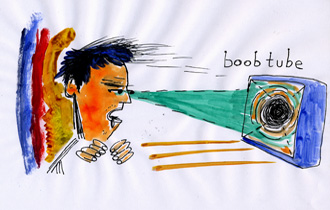
Scibona: It would be imprecise to say that television changed my life, since it started its long campaign to smother any pleasure I might take from life before I was born. I must have heard it in utero calling to me: “Come and be sad. Sleep restlessly. Awake stupider than yesterday. Abandon hope.” But in any case it’s had a deep effect. The change came when I stopped watching it.

—How was this technology introduced into your life?
Crane: My mom, my stepmom, and both of my grandmothers were extremely skilled seamstresses, and taught me when I was in grade school.
Dahlie: I’m not sure when the roller ball was actually developed and available to the public, but I am sure that young people in London didn’t generally know about it until 1979. In 1979, my class had a project involving speculations about what might happen if we were stranded on a deserted island. My essay dealt with inventive ways to catch fish, but I couldn’t get through more than a few lines without an unforgivable smudge. Since the essays were to be glued to white cardboard placards and displayed for parents’ night, no mistake would be tolerated. Sensing my desperation, a very unusual and deeply sympathetic teacher said she had something that might help me, namely a blue ink roller ball. It seemed impossible that such a thing would be allowed, but I was desperate, and used the roller ball to finish my work (incredibly, I was even allowed to take it home that night).
D’Souza: I just spent five months in Hokkaido, Japan, studying Ainu storytelling. My hotel in Tokyo had a deluxe Washlet, and my apartment in Hokkaido had one, too. Of the two, the one in my apartment was much better because it also had a sink at the top of the toilet. When you’d flush, the water that would refill the tank would first run down from a spigot and into this sink, which was also the top of the tank. It was a really elegant design. So you could rinse off your hands with the water that would go into the next flush. So obvious and so good for the environment. In fact, my whole toilet/tub/shower bathroom system was state of the art. My tub pre-heated my bathwater according to a timer, my shower was also a steam room, and my toilet played music. There was a little TV built into the wall with a non-steam screen. My toilet and I watched Wimbledon together like that this summer. Everything in there was made of durable plastic and everything had a digital console with a lot of buttons. I felt like I was on a space station.
Scibona: In the normal way. It perched in the corner of the living room, peering down on me and my family with “suave malice” (as I think Halldór Laxness writes of a barn cat). When it was on, it seemed like the whole living world, which would have made me, watching from outside it, dead. Right?
—What was the immediate impact of this technology on your life?
Crane: We didn’t have a lot of money when I was young, and my mother sewed me (and my dolls) some beautiful clothes from the time I was little through maybe fourth grade—I had a lot of clothes that were of course, better than most store-bought clothes. For special occasions, she continued to sew me things as long as she was alive—my high-school graduation dress, a bridesmaid dress that eventually became my wedding dress, she even reupholstered a sofa of mine, and I continue to sew myself, on my grandmother’s 35-year old sewing machine, although my skills are nowhere near as advanced. I still live on a pretty modest budget, and have made curtains, quilts, and simple garments for myself frequently over the years—I enjoy it, it’s practical, and it gives me a great feeling of pride.
Dahlie: These pens were actually somewhat expensive, and since I was afraid to own up to using one, I didn’t ask my parents for the money. Instead, I saved a portion of my allowance for a few weeks and eventually raised the cash I needed to get one. For my in-class work, of course, it made no impact, since I couldn’t be seen with such a pen. But it made a difference with my homework. I used the pen sparingly, however—a very detailed and expert inspection of roller ball handwriting would, in fact, allow a teacher to determine what I was doing, and I was always afraid of getting caught.
D’Souza: The first pleasure was the surprise of the warm toilet seat after a long flight and on an otherwise cold day. And the second pleasure was being washed so clean by the toilet after doing #2 that I would definitely eat spaghetti in a thick ragu sauce off of myself. Look, the point is the thing gets you clean. It just makes smearing around with paper seem so disgusting now.
Scibona: Because to watch it required sitting still and made me feel as abstracted from my mind as from my feelings, my body, and all physical sensation, it trained me to confuse sitting still with death. As I got older and was allowed to make more of my own decisions, I simply left it on all the time. Someone once told me that if you go on vacation and leave your dog with a fifty-pound bag of kibble, your dog, unable to abstain, will have eaten itself to death by the time you return. I could not stop watching—not because I was interested, but because my capacity for interest itself was being destroyed. I was experiencing veleity—volition at its most feeble. My will was poisoned.
During one junior-high summer, I would watch until five or six in the morning and sleep until one in the afternoon. Even at the time I knew there was little difference between what I was doing and a narcotic addiction.
 —What in your opinion was the precursor of this technology?
Crane: Hee. Needle and thread?
Dahlie: Surely the precursor to this technology was tormented young people in Britain looking for ways to avoid punishment. I imagine that the wet ink effect was dreamed up by a bookish but clumsy engineer at a stationary company who was burdened by memories of being harassed at school for his poor handwriting.
D’Souza: The precursor of this technology I think is twofold. First off, I think the Washlet embodies the archetype of the clean running mountain stream. Like I think the early hominids, I think they wandered and hunted and gathered and all that and I think that eventually they came to the mountains and went up into them and they found the clear running streams. And of these they found of them pleasurable to drink, but also to wash themselves clean after answering the call of the wild. And the second precursor to the Washlet I think is the Japanese predilection for plastic robot type things with buttons and flashing lights that serve as surrogate friends in a dehumanized society. So we have the Washlet: it washes you, it is your friend.
Scibona: It seems to have replaced, to a greater or lesser degree, many things—dinner conversation, bridge, listening to your sister play the piano in the parlor, letter writing: the appetite for all these things was flattened when the television was turned on. But I think the closest technological precursor to the television is the novel, which, oddly, was denounced in the early days of its popularity in the same tones that television is denounced today, as an opiate.
Novels weren’t always consumed silently, as today; they used to be read aloud, to the family, after supper, by the light of whale oil lamps, while snow pelted the windowpanes—that is, in a way very like television is watched at its most cozy and reassuring times. Like many American readers, I moved backwards from the descendant to the precursor: television had made me sick, and the novel, whose cultural place television had usurped, was the cure.
Around the tenth grade, I read my first adult novel. An aunt in Seattle had recommended it. I admired her. I had told her I had the blues, and she gave me a list of novels. My brother and I had inherited a black and brown polyester-upholstered couch from an uncle who had died. I lay in it, reading by the light of a bare bulb in a ceramic fixture behind my head. Felt pennants celebrating all of Ohio’s major baseball and football franchises were tacked to the walls. It was a Saturday morning.
From downstairs, the television entreated through the heating register; I got up and muffled it with a copy of the Columbia Encyclopedia that my grandmother had given me. Then I lay down again, and I read all day long. I must have stopped for dinner and then gone back to the book.
Sometime that night, I took a minute’s break to go downstairs and get a glass of water from the tap inside the refrigerator. The water was incredibly cold. It seemed to have a sweetness specific to water that I had missed in fifteen years of drinking from the very same tap. This was only one of a thousand lucid sensations that were flooding my consciousness at that moment and that, in so doing, expanded its volume in an unprecedented way.
I was awake. I had never been more awake. All of my senses were open and avid.
I knew that it was reading the novel that had done this to me. I had heard the rumor, mostly from television, that some people regarded reading literature as a sacred act, but I had never known first-hand what the fuss was. I had spent my whole life asleep and hadn’t known it until I had been woken up by reading.
—What evolution would you like to see as it relates to this technology?
Crane: Honestly, I’ve seen the new sewing machines and I have zero interest. They embroider, they have computers that do all kinds of things. I can embroider quite well by hand. I just need it to go backward and forward. As fascinated as I am by technology, sometimes I’m not convinced we’re any better for it.
Dahlie: I’d like to see more ways for young people to resist coercion. I’m not sure what the status of the fountain pen is these days in the UK, but I can’t imagine it’s the same, given all the obvious changes in technology. For my part, I always hated the bizarre adult fanaticism for teaching young people to read and write, although I suppose I can see some merit in it today. All the same, I’m still not sure it was worth it in my case, especially since my penmanship remains terrible.
D’Souza: Honestly, I’d like to see the Washlet make the leap across the Pacific in a big way. Because ever since I’ve been back I can’t get the thought out of my head, at the movies, at the supermarket, ‘Everyone around me right now has a dirty asshole.’
Scibona: To this day, if there is a television in the room, it’s a struggle for me not to turn it on and sit down in front of it. I can’t own one. Hotel rooms pose a special challenge: the smallest I ever stayed in—only half again as wide as the bed, and lacking a window—still had room for a color television and two dozen channels. My hope—unfair to all the non-addicts for whom an hour in front of the tube is as harmless and pleasant as a beer after mowing the lawn—is that all the televisions will be eradicated from the world.
Jaime Clarke is the author of the novel WE’RE SO FAMOUS, editor of DON’T YOU FORGET ABOUT ME: CONTEMPORARY WRITERS ON THE FILMS OF JOHN HUGHES, and co-founder of POST ROAD, a national literary magazine based out of New York and Boston.
