What Not Sleeping Starts To Make: Blake Butler’s Nothing
15.10.11
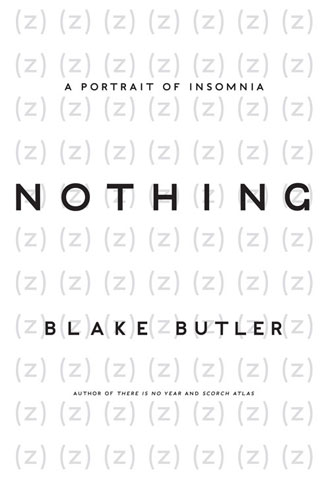 To start: a brief review of There Is No Year and Nothing: A Portrait of Insomnia
…
There Is No Year
by Blake Butler
Harper Perennial
April 5, 2011
paperback
416 pages
The table was filled end to end with food. There was so much food on the table that there wasn’t any room for plates. The family picked the things they wanted out of the serving dishes, some of which were larger than their chests: pink meats and bruised fruit, slaws and sauces, all soft enough to eat without the teeth, pervaded by a common smell. No one knew who cooked the food. The father assumed it was the mother. The mother assumed it was someone else. The son didn’t think about it–he was already saying his own prayer in his head. The mother and the father waited for someone to say grace. They’d been saying grace for years together though they could not remember who mostly said it for them. They each kept waiting for one another to begin. Each time the father thought to speak up he’d feel like the mother was about to speak herself and so he’d stop and wait and then she wouldn’t. Under the table, the father rubbed his crotch seam with his thumb. He ate.
-page 35, 36
Here: The family is dissolving. The nuclear family is losing its strong force, its weak bond. Or if in this book it’s a magnetism, it sometimes rapidly and violently switches poles. The power keeping the atomic group (mother, father, son, daughter) has and always will be known as knowing; you better feel you know those around you, those in your house. Knowing, the faulty and locking aim and state, is both sun-beaten and eroded in this book.
The regularly-bound family is contained in a dissolving film, a record, a temple of permanent confusion, confusion that warps in and out of more blank states: anosognosiastic blinds, yearning bases, terror. Knowing, with these bodies and this home (the biggest, sickest body), is now a fully quantic state that both exists and not exists; light is a wave, coming like nausea, and a particle, dirt under your fingernails.
Through these holes the light could enter, thereby: naming, thereby: age. Inside the light and homes the people made more people. The light, unlike the people, went on and on.
-page iX
Here: light is a menace and willfully malignant. As both a beginning and end marker for the book, it opens and closes the huge sickness that brays for bodies: the father, his wife, their son, their replicas. In this book, light is important and named, then renamed and renamed again, frequently, just language; both are tumorous operatives, endlessly replicating and growing (black boxes appear, swell, spit out more boxes), the language being a particular cancer that communicates obliquely (known and unknown lexicons appear ridged in walls of the family house, on skin in ink, in reflections and air and good and sound.) Sickness, honestly, is an anchor: the son was once sick, the family coped and organized. And for the seemingly burped-out and gleaming whole of There Is No Year, the now-quantum, now-entropic family both fights and welcomes an illness of the foundations of sense: space, time, light. Everything goes soupy. And what is sussed from this book’s sound, sense, and story is a truly new way of thinking.
The black creation that’d been seated on the neighbor’s house’s front lawn all this time had by now spread around the structure, further on. It had covered over the old doors and windows with new doors and windows, such as the one the son had come to stand in front of, sopping wet. The son did not see the swelling structure. The son did not see the street, nor his own house there beyond the pavement–the same house they’d live in all these years, they did not know they’d never moved. The son couldn’t see much for all the glaring–even if he had seen, even if he wanted, his house would not be there. The son felt sure that he’d arrived.
Yes.
-page 243
This novel is a reset button. It illuminates the reduced and maximal (paradoxical and clear) force of language. It carries the logic and construction of a family to its inevitable stress test, its inevitable conclusion. It lifts those bafflingly functional sensory guides of ‘light,’ ‘color’, ‘sound’, ‘age’ to a place just out of reach of implicit understanding again. Simply: this book can make you feel ancient. Gaze.
….
Nothing: A Portrait of Insomnia
by Blake Butler
Harper Perennial
October 11, 2011
paperback
336 pages
Nothing, in a light, is a coda. It heralds a cosmologically grand (think burnt out stars) attention to the endless and terribly incomprehensible filthy energy that surrounds us. How air is not clean or disposable at all; air is full of past farts, desire, old food, dead skin (all dust), forgotten faces, exits, openings, doors, traps. On its face, it is a book about a person’s time with insomnia, or, more appropriately, time without sleep. The book operates under an equatorial energy: heat accumulates off of the common alliterations of the young spirit of American childhoods, the familiar do-or-die fate of the discovery of porn, suburbs filled with reamed out houses, the inability to know what’s stuck in the tree above you, the want to bury yourself (to find yourself again much later, and how changed?), nights filled with restless monologue (conversation towards someone else, someone Othered, if pushed beyond enough), time spent in arbitrary realms of chosen symbols… All terrains that maybe most of us have felt, partially at least. But then the book opens into a sort of structural dopplegänger for insomnia: ‘What Not Sleeping Starts To Make’, a section that is entirely without reference in my mind, and an incredible force that I haven’t glimpsed in literature. Jungian archetypes filter through the bizarre physics and hidden logic of a dream set, but unlike the common wavy-white-light punctuated dream sequence, this segment is a pervasive and brilliant sect of imagination that molds the book around it. I would call this book philosophy, as it strays from memoir-like rehashing and painful-reckoning, etc… But, still, contained within is a vision of self that struggles and seems to fend off both a mirage and a blindness. Tendrils of awareness and a scarily algebraic sense roam through the book and link up the feelings, the experiences, flattening or fattening or evening out seemingly scattered planes of life, of I, of sleep. In only the way that the best literature does, Nothing collapses the reams of known and unknown, the centered and spread, into a graspable yet endless plane. I’ve known Blake for a long time, and besides his presence in my life as a friend and collaborator, I happily say that this is his best book. It, too, is an attentive and honest impression of his insomnia’s brethren: his father’s dementia; the way the build and bent of a regular mind, its averaged emotions and self-conscious equilibrium can scatter, like pieces of lead in flight from an opposite magnet. All this comes aside a full glaze of sleeplessness, its new name, its history and potential application and medical injuries or annulments, all of which is very much the first layer of a gorgeous and horrible door. But the space inside, behind the door, the obliged surface: what is left, hiding, between you and the other room of this book, is what is so great, and what I will leave alone. We’re surrounded enough. Because within Nothing is a constant thickening and shedding of everything one could ever speak or hold away: all lines of love, terror, filth, fight. And then beyond that, even, is a quiet and uncontainable recursion: a curse, yes, but also all that air of ours.
(or Nothing)
And then: a long interview with Blake Butler
…
Ken Baumann: I found your blog years ago. I arrived at it from Tao Lin’s blog, which registered then as unique in tone, in constant style, and the design even mirrored and amplified the content. I thought, and still think, that your blog has that same artistic presentation. Does accumulatively designing your online presences and spaces feel anything at all like writing (and, inside that: editing) a book? Or more like a picking out clothes and dressing hair?
Blake Butler: I think everything I do in front of my machine comes out of the same box of flesh and garbage breath I get from sitting here all the time. It’s both pure and stabby, because I’m free but there’s nowhere else to go. Or there’s everywhere else to go but I don’t ever go there and when I do go there I feel insane and want to be in front of the machine a lot except for in small visions. Maybe it’s not the machine but me. In front of the machine I can explode a little into the buttons instead of in other ways people explode. It comes out all over the word processor and into the websites. These vary like channels or users on the same box. I move between the channel on impulse mainly. I type on the work that becomes the books until I feel something in me shatter, which could be 5 minutes or 40, and then I’m clicking around in the sites to find something to click the sites in me into either like cleaning away what just shattered, or to shatter it in another way, like reading junk that people spew in the sites where I spew and my own spewing in such calms me down and I can shut me up for that banana crap and find the hole in me again and move into the other channel. All the channels are both mirrors and voids and eternally hungry for tacos that I mostly won’t let them have because I want to starve.
K: What’s the importance of the "straight man" inside Steve Martin? There is great pleasure in playing the blank, right?
B: I believe Steve Martin is wholly possessed by the straight man. There is a purity in his gesture and eye that comes out of something beyond him, like what comes out of children, but only children in photographs. The Steve Martin who has human sex in life and maybe did drugs and whoever are fuzz around the meat; they are as well the realest part of him as human, though the human is disposable. Being disposable does not make that part unimportant, but it does suggest that the blank is the place and the place is the blank. That is, yes, the pleasure in that blank space comes not from the ego or the identity but the thing about the meat that is not in the meat at all; not more than meat, but caught in it. Squeezable. The thing that makes you want Wendy’s on a cold afternoon in March having sat and typed all day into the machine. The pig in the human wanting potatoes and just instead farting out these codes. The Jerk is a magical example where this iteration of recognition and void is so adeptly covered over and reflected back at itself that the human as meat can only respond in laughter. It looks like a goof or a kneeslapper, and is, but is also contained with this magic box like skin of babies. I mean, pure and foul at once. Steve Martin as the body of Navin Johnson assigned to guess the weight of the stranger and failing and shuffling off a nodule of crap and feeling remorse for having lost and being told he has not lost and going to fuck in a trailer where he accidents into his cock not as a seducer but as the manipulated and the bitch and smiling for it because he is the child and he believes. I think maybe that’s one of the purest functions of the creation of objects as a result of brushing up against or being in the void: belief as projected through and bent to try through and going on whatever crap is all over your arms. The void isn’t empty, it just needs and needs, more than even you.
K: Correctly I must followup with this: a bit unfair, since you’ve mentioned this idea to me in the past, but now I want you to put down the first paragraph of the essay on Chris Farley, his death, and 9-11.
Secondly: world as empty egg, desire the lost germ. And what feels most both wanted and focused on is the presence hidden in the presence.
B: I think if I ever actually wrote the essay of why I believe 9-11 was caused by the death of Chris Farley it would come out in the form of a novel or something. Like maybe Ever is that essay. But at its heart: I think that a significant and hellish shift in America occurred when Chris Farley overdosed on December 18, 1997, while his symbiotic, wry, shit of a duo-partner, David Spade, continued to live and breathe and eat in the U.S. air. This was the death of our last fat funny man: the humor of heft and gesture and organism rather than that of irony, smarmy ego jokes, and being a dick, as espoused by said Spade. The shape of American humor from that point forward was allowed to veer heavily into the suffocating, meatless bitchsack that since then has come to rise over our pale, and suck the face out from behind the face of even more of our culture. As a result, the world’s urge to destroy what America represents reached a critical mass and became a plane that flew into a building and killed, and marked. As David Spade would say: Whatever. I honestly believe if the roles had reversed, and Spade died and Farley lived, we’d be in a different world now. We’re not. I can go on and on from there about vegetables and Wendy’s and emotionless consuming and babies and masturbation and machines, but it’s too late anyway; the egg is covered in white out from off the desk of that junk TV show Spade went on to do in the veil of his friend’s death. What was that show called again?
The presence in the presence is everything we’re not doing, which is everything.
K: Much more plausible on the face of it than a butterfly’s wing movement causing a hurricane 5000+ miles away. In a close vein, I continually love and am surprised by, newly each time, the physics of the worlds in your books. Bodies, surfaces, air and light and sound all warp, change aggressively, leach and feed off each other and endlessly pervert. It’s like a wild self-eating system. Any weird parallels between how you run your body and how the sentences and energy web of the texts relate?
B: The text and body parallel is a good one, I think; everything with me is either glut or beatdown, I think. I like to think of books as made of skin, even if the skin is dead sheets or sheets with termination periods. I like to think text can defeat humans in that the replication of the self can occur in a similar form, and that we are not special for birth moves and for shifting silence. A dot can be a window, etc. But that’s not to say that a book is a child, because it isn’t; it is a cold room that closes on itself. No matter what you say in a book it will not become a limb or become food, though it has this silence in the blood. When I run each day the five miles that I run or whatever, and when I don’t eat all day and then eat a shitton of fat kid food for one meal, it is the same yeah kind of network I want to have in my life as in what comes out, though not by choice, but because I’m this big goof with hands who keeps playing the game and remembering certain sections of code that need to be deployed. Erasure is as important as the laying down, and going to Wendy’s is just as important as having water. I’m very hard on myself as a person because this idea of interacting with life through keys and white space and machines is an eternal nothing, though somewhere in there you bump up against these worlds that are nowhere else, and can only be reflected in pictures or little sounds that most will not hear and even less will take the way you meant, and even less or maybe at all how you did or were. Being in those zones for little instants is worth the blank or whatever else it takes to get there, or maybe it isn’t. Anyway, here i am. If I won’t kill me, I’ll kill what comes out of me and be fine in watching it squirm and whoomp surrounded by doctors and then other babies and then physicians and then bosses and then other kinds of doctors and then dirt. You learn maybe in getting older faster to sit down where you are and put your ass on as much of all that dead as you can.
K: The last portion of that response is death, but for some principle, let’s push past it. What’s unavoidable in the online worlds or making and communicating is a constant adjustment process of interpretation: you’re applying so many voices to so many dead lines of text. Especially in forums, such as HTMLGiant, those voices can be sometimes pretty radically misfelt, even if mostly by accident. Does this massive supplication of voice help your head deal with writing and taking on, in, and forward other voices in your offline writing?
B: I don’t think anything’s any more death than anything else really. Eat some nachos and feel your center get melted like the same way you break a bone but concentrated differently. Death is fun, why not. I never understood the fear of death. If anywhere’s death the internet certainly is, everybody circling this big fartbody that both has on nice necklaces and nodes to get to other portions of the earth but also all these sleeves of poot all over it, and the scratching, and the replacing of cells that slowly train you to no longer be a human in the historical sense and more a machinebeing. All those books rattling about what it is to be human seem to disregard that what we are is changing, for the worse I think; the ways thing milk is turning more and more into code rather than sunlight. But that’s fine: I’m not against it. If anything, in those modes of typing, I thrive from it, even if it’s suffered my ways of being a human in the old sense. And no, being in the stir of that shit doesn’t seem to help either really: I mean, it can, it’s nice to hear smart people typing smart things that I wouldn’t have ever gotten to hear otherwise because my limb on this nast body is so far from them spatially; but it also kind of waters the milk at the same time in a way where I find it harder and harder to remember anything; names, hours, sentences, where I was, what I said, what anybody else said to me; it all seems to fall out by getting endlessly buttreamed by all those other sounds. So it’s a nice mill effect, there’s a constant feed, but it also brutalizes the receptacles, and makes them turn in, which seems a clear affect on my as you say offline writing for that inward and outward barf-spinning and reflector circuits, but also in a way that makes every word I type feel not at all like mine the second I look at it coming off my hands.
K: I could play canned-psychoanalysis and ask you to say more about the feeling of not owning or being connected to the words, because they are just code for most of your interaction, portioned, cordoned, broken up into simple systems then rebuilt and displayed in other cubes within cubes, very abstract and cut off from the sensuous or performative or fleshy. We totally miss smell, online. Pheromones traded for usernames. But instead I want to ask you about your dad. If at all you would prefer to not type about it: no problem. You told me recently a few really tough but interesting things about his dementia, his newer behavior: facing him and confronting him as a way to shortcircuit him, in a way, and his violent energy. Could you write those events out here? Without feeling too vulgar, I’ll mention this: it occurred to me (in a museum) that art, as a basic node of human action, is a safe place to house insane behavior. Not just applicable to performance art: the creation of nonfunctional grotesque objects, timedumping thousands of hours and materials into certain structures, putting blocks of color together in a way never found in nature, flattening, reproducing endlessly without reason or improvement…
B: Today while watching after dad I went into the kitchen and found he’d scribbled all over the counter with an orange crayon. He’s writing on everything now, mostly as a product as my mom encouraging him to write and draw so in notebooks to reroute his nervous energies that he often uses to bang on glass and hit his fist into his hand with very hard. He was used to working all his life, his own businesses and in the yard, and running every day; he did not like to sit still and is still in very good shape for his age, which is part of what the destruction of his mind has made even stranger. I told him he’s not supposed to draw on furniture and he said he hadn’t, that he saw me do it, and that I wouldn’t get away with that. Then he started singing a la-la song and trying to turn on the water in the sink that we’ve strapped down with a rubber band because he’ll just stand there and run water all day if it’s not stopped. He likes to stare at the water moving. In the freezer today I found a ziploc bag full of four hats of his, they’d already gotten a little firmer around the edges and the bag was moist as if the hats were breathing. He said he didn’t do that either. He said something about something coming to get you faster. When he says something it often makes sense in his head to him that instant and the instant holds a bit and then is gone and nothing is true. Given command in that instant he will take over anything and demand it all; my mother often gives him what he wants, talks herself into believing what he’s asking for is what he means, within a certain parameter. She will go along with him, make sense out of his constructions. I do this sometime, play along too, try to talk him into maps, but when he gets angry most he will speak at me as if I am a evil stranger and I have come to take his food, invade his space. He is protecting his air from what he doesn’t feel familiar with, which is everything now, except inside him. He used to always be such a trusting, giving person, and still is often, though there’s this black circle moving in around who he was. When the circle is stronger, such as he wants to punch me for drinking water because he thinks I’m stealing from the house, or when I try to tell him he can’t put the full tub of ice cream in the dishwasher, and he begins to lash, rather than play along I will tell him he can hit me, that I am stronger than him and that will be fine, that I am here and I am going to drink the water and there’s nothing he can do about it. This often oddly stops him and he’ll turn around and go and look out the glass at the yard and try to open the locked door again for the dozenth time that day. I feel strange being strong or rude at him in these instances but instead of entering his looped logic again about something as such it seems to defuse his animosity, turn him back in on himself, and the next instant he’s forgotten, his tirade is washed under in the destroyspace and he is quiet and often funny and kind enough and somewhere in there yes, if just a tiny piece now. The analogy of the museum seems very right to me quite a bit, that he is rolling around inside this space that is made of the damaged and yet safe, he can not be hurt here, there are all these relics. What disrupts the relics from being spinworlds for him often is food, sleep, noise, and temporary exit from the house, into the world as a person on tour of a place he used to go free.
K: This upcoming line feels both vulgar (it is) and tired, but I think it’s something nonetheless and something that I feel you reference, write in and out of often enough for me to notice not a trend but an occasional, sharp bent: suicide. How the days after David Foster Wallace killed himself were both painful in an ache, because of the distance to such a huge figure in some minds, and direct, in that there was someone who could lay out the exact parameters of so many situations and steps: death, the mundane, the ordinary, the spectacle, fate, addiction, longing and then he and all of it for the rest was gone. Since then, I think you’ve written about suicide as a sort of rest, both unfair and ordinary itself, as a less brave way of dying, dodging the days. What space did that clear in your head? In the years of extreme insomnia you went through, did killing yourself ever present itself?
B: It didn’t clear any space. Whatever space is in my head left is just a patch spot like on a record played too hard in the same grooves. The second I started answering this question after staring at it a few different times the phone in this house started ringing over and over; I’m here watching my dad again and the phones here ring longer and between each ring announce who is calling in a robot voice; my dad thinks shouting back at the phone answers it Hello? Hello Hello? David Wallace killed himself and I don’t blame him. I don’t think a day passes I don’t think about it, even if I know I’d never do it really because my sense of human guilt is too powerful in me. It seems both courageous and retarded, like most anything else you do here, like making things to look at in the meantime. I write so I can kill things and feel dead too. I read so I can feel more alone. It doesn’t seem morbid, it seems like a mirror. How many sentences will you read or times will you laugh before you don’t anymore. That seems comforting. Why be afraid of death, you’ve had so much practice. I don’t know.
