Bury My Heart at Tataouine
11.06.09
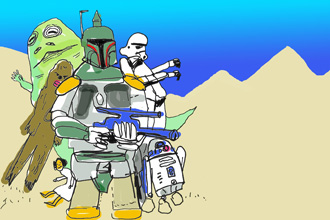 Moussa sees the new visitors to his land with the perspective of countless millennia. This Amenoka—or chief—of a small population of Tuareg Berbers in southern Tunisia tells this reporter through translation, “We have wandered the desert from edge to edge since before time. We have protected our language and way. If they have come to the desert for their god so be it. It will not upset us. We call them kel Ataram because they are from the west. They call us Sand People. We do not know why.” His face covered by a deep indigo veil, he takes our crew to the site of the massacre that has shocked the international community.
Moussa is referring the growing population of Star Wars fans who have migrated to this arid region to live their life in monastic purity on the same land used for filming several of the franchise’s most famous scenes. As a cattle herder and goods trader wandering the uppermost tip of the Sahara desert, Moussa has been witness to the birth of this new and little seen sect. It’s a group—it should be noted—not without its controversy here and at home. “They never wanted much in trade, I sold them two, perhaps three, DSL modems,” Moussa says of the young people who called themselves the Rebel Alliance. “They wear brown robes. They are generally fat. Fat like boars and pale like milk. That is odd in the desert.”
Odd yes, but the group had odd beginnings. In the early 1990s Lucasfilm Limited inaugurated the lucrative practice of guided tour packages to Tunisia. The company had re-erected many of its sets as expensive hotels, which thrilled fans and became a steady revenue stream for creator George Lucas. Then in 2002, just after the release of Star Wars II: Attack of the Clones, a group of the fan tourists overtook their guides in the middle of a Wookie symposium, and claimed the resort as their own state. Eyewitness accounts stated that the group celebrated for days and nights, playing what they called “Ewok music” on primitive drums and small Casio synthesizers.
The ringleader of the coup, calling himself Obi Wan Kevin, announced to a US diplomat soon after that the rebel sect wanted to return to the “true word” of Jedi Masters and to “purge the franchise of control by the dark side.” Though born Kevin Oakley in Ann Arbor, Michigan to liberal school teacher parents—and known as “The Oak” to high school peers because of his girth— Oakley quickly ascended the ranks of Star Wars fandom to control the most popular website dedicated to the series, The Dahgobar Times. Feared by many for his trenchant adherence to canonical lore, Oakley made his first headlines only a month before the coup when he issued an internet-wide fatwa, calling for the head of actor Hayden Christianson, the wooden thespian who was given the role of a young Anakin Skywalker. The FBI was preparing an indictment against Oakley for the death threats when he disappeared. He did not surface until the Tunisian coup.
Some members of the coup trickled back only days into the siege, telling of horror stories of Obi Wan Kevin’s dictatorial methods. Neophytes were often beaten while blindfolded, with Obi Wan Kevin admonishing them to “Use the force. Use the force.” Now most Americans know Obi Wan Kevin from video footage of the bearded, dirty and wild-eyed messiah on a stretcher after capture. He has since been incarcerated for five years without trial. The US Army has blocked all efforts to contact him by the press and the Oakley family. It has been rumored that the capture of Obi Wan Kevin was made possible by tips from his own lieutenants.
Yet the colony Obi Wan Kevin founded thrived and members accepted the fate of their captured leader as “just like being frozen in carbonite.” Lucasfilm has officially washed its hands of its properties in the area, denying any knowledge of the city now christened “New Alderaan.” Attempts to confirm this story with the Tunisian government were also met with silence. Tunisia is tight lipped about its affairs in general and the region in question is little populated, save for the Berbers and the newcomers. Until two weeks ago initiates were arriving daily, resulting in an estimated colony of 500.
“Most have scattered to the mountains,” Moussa says as we near what the sect called the Cantina. “They will talk to us, but no one else.” It was Moussa who discovered last month’s carnage. As he closed upon the small settlement with his herd in tow, he saw something wrong. “Many times when I passed at dawn, they played with sticks, either blue or red in color, hitting each other. That day I saw buzzards. Going closer there were many bodies. Some were burried. Others not.” Those bodies were now gone, taken by the Red Cross but the “sticks” lay on ground, already being buried by the gusting sand.
Knowing the Cantina building to be a mosque originally, our producer asks Moussa if he thinks religion may have been behind the attacks. “No,” he answers. Moussa then takes from under his coat a wine bottle. Passing it to our cameraman, Moussa says, “Look not towards Mecca but west, to Napa.”
Moussa and others claim to have found several drained bottles of 2002 Skywalker Ranch Viandante del Cielo Chardonnay around the massacre site. These bottles fueled rumors that Lucasfilm was holding a summit with the sect, which ended with misunderstanding and bloodshed. While this theory posted on Metafilter by a user with the screen name “Yoda’s Choda,” the State Department is taking it seriously enough to investigate the movements of several Lucasfilm executives in the last month.
Yet with sect members still in hiding and the vastness of the desert itself, a full picture of what happened at New Alderaan is not likely anytime soon.
Without anyone tending to the buildings, the sand is already gathering up the sides of the whitewashed domes and creeping into open doorways. The immense riches of Star Wars collectibles that fill nearly every corner of every structure are slowly warping and fusing into one plastic mass in the heat. I pick an oversized Boba Fett figure up off the floor. Once valued for its see-through scope eye, smaller figurines are stuck to the doll like clusters of corral.
Next week, Moussa will be leaving the area and taking his herd north as summer hits the desert and the already oven-like temperatures increase. “One must move with the sand. That is what the desert asks of us,” he says as he brings us back towards town.
Note: If you think Tataouine should be spelled Tatooine, see here. Based on the real city in Tunisia. From Davis- “I went with the real spelling since my story is set in the real area. not the fictional planet.”
