Everybody Loves Ramen
16.03.10
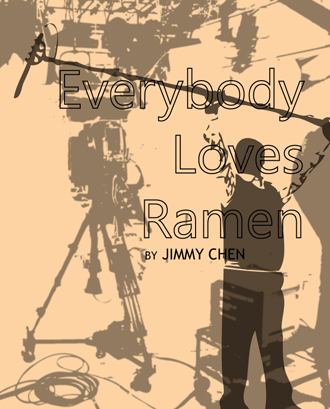 Everybody Loves Ramen is a television sitcom about the Wong family, middle-class Asian-Americans living in an unnamed suburb, presumably in the California bay area. First aired on September 20, 1996, the show ran for six seasons on the NBC television network until April 20, 2002.
It is best known for its revolutionary meta-fictional take on television, in which an anonymous boom-mic man faints off camera in every episode, his presence only ever alluded to by the loud thud and scripted "in camera" concerns of the actors and cued mumblings of the audience. At first publicly received with hesitation, especially among the less media savvy middle-age to elderly demographic, NBC eventually sold a record breaking 6.4 million I FAINT t-shirts from 1996 – 1997[1].
Of the Wong Family: Father Ronny Wong works for a software company; mother Lance Wong is an elementary school teacher; their two daughters Christine and Mickie, aged 11 and 14, are perky and energetic grade A students. The paternal grandmother "Nana," having suffered a stroke, experiences severe dementia and delivers some of the show’s funniest lines. Other cast members include: the myriad of children who are friends with the daughters (including the lovable albino boy Rupert); Lance’s younger sister Tessa Lu, a romantically challenged administrative assistant living in the city; Ronny’s tennis friends and co-workers; and neighbor Bob Stark, a conservative veteran who often comes over to complain about the loud Cantonese being spoken.
One of the show’s progressive inclines focused on Bob Stark’s archaic and bigoted views, though he was portrayed empathetically as a good man trying to acclimate to the changing world. Bob Stark would go off into intangible right-wing sociological arguments while the Wongs patiently listened. Such dichotomy implicated the growing strain between liberal and conservative sensibilities; that Asian-Americans were made the ambassadors of tolerance for the first time ever in contemporary culture, offered a complex dynamic which audiences rejoiced in though sometimes struggled with. The show, however, unintentionally elicited ambivalence in the Asian-American community, some of whom felt that Korean, Japanese, and even Hawaiian actors playing Chinese characters only propagated the racial notion that their maxillofacial qualities were indistinguishable.
At the conclusion of every episode Ronny Wong would prepare dinner, an intended inversion of gender roles, as the Wong family represented, according to Entertainment Weekly, "the new post-American family."[2] The show’s creator Kay Boyd, a tireless advocate of the Wong’s vegetarianism, notes the length at which he fought the studio executives to incorporate a unique vegetarian ramen recipe into every episode. With the growing success of the show, and an endorsement from both PETA and Maruchan® Ramen, Boyd eventually got his way.
Cornell West, in his Princeton lecture "The Visible Invisible Man: Meditations on Albinism in Popular Culture," proposed that Rupert’s albinism represented an enlightened sans melanin "anti-ethnicity," a retroactively provocative negation of skin color which functioned as an indictment of racism in the United States.[3][4] Samuel L. Jackson (or his very talented impersonator) is heard in the recording in the background saying "damn straight" numerous times at fluctuating decibels.[5] The sociologically prophetic role of Rupert has been purportedly corroborated by Boyd himself, who, ironically, is color blind.
First criticized for its pun on "Everybody Loves Raymond," executive producer Marc Feinhorn replied "our semantic pastiche is a cultural critique of pedestrian values and the corporate agendas under which they serve."[6] Ray Romano, the star of Everybody Loves Raymond, retaliated "what the fcuk," [sic] albeit futilely on the show’s ostentatiously designed yet obscure blog.[7] The exact reasons for Ray Romano’s 2003 suicide is a point of contention between fans of the respective shows, though it is commonly accepted by the general public that Romano was severely depressed over the phonetic usurpation of his show.
 Controversy broke out in 1999 when neo-conservative magazine The Weekly Standard published an Op-ed suggesting that the Wong family, as immigrants without full control of the English language, were subconsciously the "Wrong" family, that the liberal media was complicit in their attempt to phonetically render the "wrong" politics right.[8] Such semantic assertions were absurd, and editor William Kristol later apologized publicly, however insincerely. Dissenters of the show, led by the Alabama Baptist State Board, garnered media attention for the racial allusions of WHAT IS WONG WITH YOU? written on their Church marquees.
Philip Seymour Hoffman was allegedly offered 2.1 million dollars to guest appear on the series finale to play and officially disclose the hidden identity of the fainting boom-mic man. Hoffman turned it down, after receiving death threats and/or bribes estimated cumulatively at 5.8 million dollars, to the relief of critics who believed it was the very non-identity of the boom-mic man which became a metaphor for the inclusive second-person pronoun pandering to the inherent narcissism of a multi-generation of television viewers who imagined themselves as the famous boom-mic man, a phenomenon which became known as "the self-democracy of fame." The show made history in 2001 when the fainting boom-mic man won an Emmy for Best Actor in a Comedy Series. The writers, needless to say, accepted the award on his conceptual behalf.
In the series finale, actors playing the writers of the show are seen at the kitchen table frantically writing options for a spin-off series called "Never Ending Noodles," a conceit which seemed strained and too eager in its self-reflexivity for most audiences. Feinhorn optioned the spin-off to HBO and was in the process of producing the pilot when he suffered a fatal stroke, which his family attributes to his high blood-pressure resultant of the high-sodium ramen dishes he had every day in solidarity with Kay Boyd. The pilot was never made, although in 2006 a theatre troupe at Emerson College produced Never Ending Noodles: The Play which was unfortunately met with lukewarm reviews.
The huge success of Everyone Loves Ramen is seen as due to its provocative devices, namely, the fainting boom-mic man, "raceless" Rupert, and the vegetarian ramen recipes – all demonstrative of a collectively held fictional imagination, what a cultural critic called "the structure and imperative verity of disbelief."[9] The show led the Nielsen ratings at No. 1 for an incredible three-year span. In 2003, TIME magazine named it "the most important television show ever made since the 19th century."[10] Everybody Loves Ramen not only incited the scrutiny of comfortable cultural notions of sociological values and meaning, but most importantly, preempted the fall of American television by conceding to, if not celebrating, its very artifice.
