The Beaches of Agnes (2008): a documentary by/of Agnes Varda
08.07.09
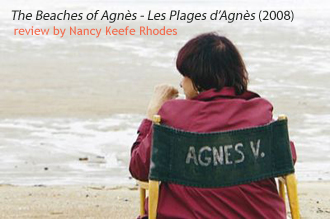 The Beaches of Agnès/Les Plages d’Agnès (2008)
Director: Agnès Varda
Cast: Agnès Varda, Rosalie Varda and Mathieu Demy, Jacques Demy; Anne-Laure Manceau as young Agnès
A Cinema Guild release. France/French with English subtitles, 108 minutes.
Of all the ways that French filmmaker Agnès Varda, just turned 81, might frame discussion of the French New Wave in this self-portrait documentary, she mirthfully chooses a giant orange-tiger cartoon cat with a droll, mechanically filtered voice to introduce the subject for posterity. The cat is actually long-time friend and fellow filmmaker Chris Marker, bobbing along disguised in cardboard cutout as his own character Guillaume-in-Egypt, inquiring “What about…?” off-handedly during a stroll through a crowded Paris street.
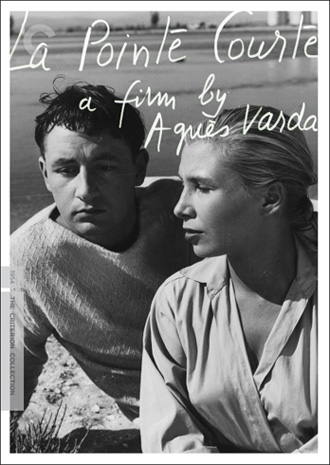
She recounted just as casually, after Godard had gotten Georges de Beauregard to make Breathless in 1960, that the producer asked Godard if he had “any more pals who could make the same kind of cheap black and white films.” She tells Marker that Beauregard “wanted a stable” of filmmakers. Beauregard made other Godard films, some of Jean-Pierre Melville’s and in 1961 he produced Jacques Demy’s Lola. Getting the same recruitment query, Demy suggested his lover, Varda, whom he would marry the next year. Varda had made one feature in 1954 set in a coastal fishing village, La Pointe Courte, followed by a handful of shorts, and also worked as a photographer. So in this way Beauregard, with Carlo Ponti, came to produce Varda’s acclaimed Cléo from 5 to 7.
Since this discussion occurs well into the film, we already know Marker’s been coming around Varda’s rue Daguerre compound in Paris since the days Varda convinced Alain Resnais to edit La Point Courte. So they have clearly colluded in staging this exchange as a kind of advisement against hoping for portentous announcements at the last minute. Instead, Varda inserts a short clip from Cléo (Corinne Marchand as a glamorous singer trying to fill time before she learns whether she has cancer). She then comments on filming a story in real time and the inspiration of medieval painter Baldung Grein’s images of voluptuous women embraced by boney death figures, then briskly moves on to her 1962 trip to Cuba to photograph Fidel’s “revolution cha cha cha.”
 Varda shot The Beaches of Agnès over two and three-week stints between August 2006 and June 2008 with six camera people in all. Half, including Varda herself, used a Sony V1, the small high definition video camera that she began using a decade ago for The Gleaners and I; the others used a big video camera. She takes as her major connecting image the series of beaches she’s known since childhood: La Panne beach in Belgium (her family lived in Brussels until they fled the Nazis to France in 1940), the Mediterranean port of Sète (where the family spent summers on a docked boat and the site of her first film), Venice Beach and Santa Monica Beach in California (she followed Demy to Hollywood, a town she says “immediately seduced me,” where both made films before she returned to France without him during a separation), La Guérnière Beach on Noirmoutier Island (she and Demy made a retreat of an old mill), as well as along the banks of the Seine in Paris. For one sequence, Varda has six truckloads of sand dumped in the street outside her Paris house and sets up her office there “to justify the film’s title.”
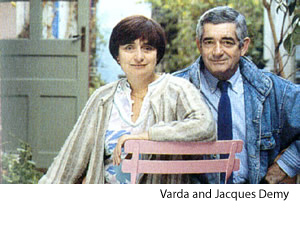
Additionally the film has two other powerful threads. One is the omnipresence of Demy, whose post-Hollywood reunion with Varda – they reconciled with the idea of growing old together – was cruelly interrupted by his AIDS diagnosis and his death in 1990, just ten days after Varda completed shooting her first film about him, Jacquot de Nantes.
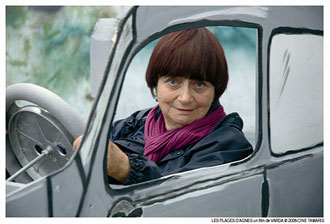
Secondly, the notion of puzzles structures the film as much as the beach episodes. Years ago, Varda’s first “official self-portrait” was a tile mosaic; now Beaches works by juxtaposing fragments from her films with her on-screen appearances, re-enactments, photos and the more recent installations (including Varda in the belly of a whale/boudoir among the dunes, specially for this film). Conventional film clips of well-known scenes as well as clips of music from the film-scores are excised from their context and used both to reference past work and anew as free-standing images. For Varda, memory works in this way rather than by historical time-line. This elaborates Varda’s entertaining opening piece with the mirrors on the beach set up by a troop of young assistants; yes, obviously the conceit of mirrors for a self-portrait, but the mirrors also represent that life’s fragments reflect one another and so do efforts in one art form resonate in another. Thus what Varda calls “my musings, pretty close to the truth, are punctuated by sketches where I put on a bit of a show. Clowning around allowed me to take a step back.”
 This also means that Beaches works for those at all degrees of familiarity with Varda’s work. It’s deeply satisfying when a fragment of a film you’ve seen before triggers your own memory of the whole, but it’s also credible that an entirely new and young audience – who seem to be showing up – may need no familiarity at all with her films to take in her approach to experience.
Varda’s exchange with Marker over the New Wave may even be redundant, except as a kind of footnote. I’m thinking of the spot early on where she recounts that she was conceived in Arles and named for that city, but changed her name at age 18, all the while writing her given name – Arlette – in the sand with a stick, only to have an incoming wave sweep over the letters and recede, leaving again a virgin field of sand washed clean.
Varda held her own with New Wave theorists, mostly men and many of them ex-film critics. Whether from her other films or this one alone, it’s plain she was extraordinarily literate, capable and at ease across art forms and social classes. From Beaches one does learn some particulars, that she was educated in art history at Ecole de Louvre, was a photojournalist and official photographer of Paris’ Théatre National Populaire, was intrigued by the narrative structure and experiments of novelists like Faulkner and Natalie Sarraute, is now still running the “family business” production company Ciné-Tamaris out of her Paris house, and, starting with 2003’s Venice Biennale, has embarked upon multimedia art installations, some of which are documented in this film or were created for it. She also logged three months of working on small fishing boats in Corsica and “unambiguous cohabitation” with their owners under her belt, a privately executed walk-about that bridged her student days and her decision to take up photojournalism. But Varda came to cinema unburdened by film theory (or even much viewing at age 25), at first simply wanting to try out words with images to extend her photographic practice.
 Thirty-three films later – roughly half of them fiction, the rest documentary – she remains serenely centered in her clarity that “films always originate in emotions” and that technical and intellectual prowess should serve rather than drive the enterprise. For example, in Beaches Varda recalls her involvement with feminist organizing, especially in the period she and Demy were apart. “I tried to be a joyful feminist but I was very angry,” she says, listing off horrific abuses and offering archival footage of protests. But more persuasive – and in this context generating new flashes of revelation about why she created this character as apolitical – are the quick clips from 1985’s Vagabond that punctuate this section: Sandrine Bonnaire as the increasingly desperate drifter Mona, kicking a metal keg in a field, punching metal garage doors, furiously patching a boot with a ripped sole.
And Varda’s keen interest for reunions with old friends, casts and subjects alike from earlier films stretches back years, flowering in Beaches. To describe her satisfaction with her documentary about the time-honored French practice of scavenging harvest left-overs and city garbage, The Gleaners and I (2000), which she extended with follow-up visits to as many of the same people as she could find in The Gleaners and I: Two Years Later (2002), Varda says, “I was able to approach them, to bring them out of their anonymity. I discovered their generosity.”
 Cinematic technology’s service of the human reaches a most magic moment in Beaches when Varda returns to the village of Sète, site of La Pointe Courte, resurrecting test footage she’d shot of a local couple, Pierrot and Suzou, old friends of hers, long ago. The husband had died soon after, leaving two young sons, now middle-aged men. Mounting a projector on a hand-cart and rolling it through old town, Varda ran the test footage for the sons, who had seen their father in photos “but never in motion.” Watching Blaise and Vincent’s faces as they watch their long-passed father’s image on that very thoroughfare and you’re reminded that in some places photo – still and motion alike – inspires fear of soul-stealing. Work like Varda’s may give souls back.
Nancy Keefe Rhodes covers film, photo and visual arts. She lives in upstate New York and is a member of the Women Film Critics Circle.
The Beaches of Agnès won France’s Cesar Award for best documentary in February and now its official US theatrical opened this week in New York City July 1st at Film Forum and in Los Angeles on the 3rd. Actually a number of screenings in North America have already have prepared the ground – at Toronto’s film festival last fall right after its Venice IFF premiere, since February at film festivals in Portland (OR), Wisconsin and Seattle, and as sneak peeks in several Varda retrospectives: in Chicago and then at Harvard in March and, just winding up now, American Cinematheque’s week-long retrospective in Santa Monica. Varda has traveled to some of these to give talk-backs after screenings and in March visited New York for a number of interviews at Film Forum that are just hitting print now. The Criterion Collection’s January 2008 release of a new four-disc DVD set – her first three features (La Pointe Courte, Cléo from 5 to 7, and in 1964 Le Bonheur/Happiness) plus Vagabond (1985) – is available along with several other Varda titles at Netflix.
