The Last Station – Love, Copyright and Anarcho-Christianity
14.01.10
 When most readers hear, “Leo Tolstoy,” their first thoughts are of Anna Karenina and War and Peace—classics they should have read but most likely never did. But Michael Hoffman’s new film, The Last Station, depicts a different Leo Tolstoy, one even the most devoted literati know little to nothing about.
Although Tolstoy spent the better portion of his career writing canonical novels that brought him wealth and veneration, towards the end of his life—emboldened by a newfound faith in Christianity—Tolstoy began writing essays and articles on the ideals he wanted to impart to his fellow Russians. These warnings against social ills and private property culminated in a social movement with Tolstoy as its prophet. The Tolstoyan Movement promoted peaceful resistance, vegetarianism, abstinence from sex, drugs, and profanity, as well as the denial of individual wealth. At its height, The Movement had upwards of 6,000 followers.
If you want to learn more about the Tolstoyan Movement, much less the novelist Leo Tolstoy, you aren’t going to get it from The Last Station. In fact, you won’t even learn as much as you did from reading the above paragraph. While Hoffman’s film, based on Jay Parini’s novel, focuses on the elderly spiritual leader Tolstoy (Christopher Plummer), The Tolstoyan Movement serves as a vehicle for the narrative rather than as the content of the film itself. Instead, the film is primarily concerned with the dramatic confrontation between Tolstoy’s wife, Sofya (Helen Mirren), and his disciple, Vladimir Chertkov (Paul Giamatti).
During Tolstoy’s dying days, the brutal dispute between Sofya and Chertkov over the rights to Tolstoy’s writing grew into an all-out war. Chertkov, a devout Tolstoyan more responsible for the uncompromising manifestation of The Movement than Tolstoy himself, believes that the rights to Tolstoy’s writing should be left to the Russian people. Sofya demands that the rights be left to the family, so as to fortify their children’s future. Trapped amidst their bitter conflict is Valentin Bulgakov (James McAvoy)—a naïve Tolstoyan hired to work as Tolstoy’s secretary—and Tolstoy himself.
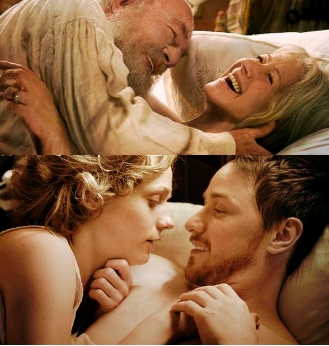
Mirren and Plummer capture the tangible and enviable chemistry that allows Sofya and Leo to endure even the most embittered conflicts. Sofya’s frequent rants against the Movement and her desire for the rights to Tolstoy’s cannon primarily appear a desperate attempt to hold onto Tolstoy. Although Plummer’s performance is understated in comparison to Mirren’s hysterical depiction of Sofya, the performances balance each other nicely. The actors create a sense of how, after 48 years, Sofya and Leo’s connection is tumultuous yet enduring.
Mirren’s performance is also adeptly counterbalanced by Paul Giamatti’s depiction of Chertkov. To the degree that Sofya is irrational, Chertkov matches her in his depravity. Having the two characters dominate Tolstoy signifies that the confrontation has less to do with Tolstoy than Chertkov and Sofya’s inability to relinquish their conflicting roles in Tolstoy’s life. Sofya continuously falls into Chertkov’s plots, providing the film a comedic element while entwining the other characters within the ceaseless tug of war between these two outspoken figures.
Although Plummer situates himself nicely between the oversized performances, James McAvoy’s Bulgakov pales in comparison. He’s unconvincing as the meek zealot Chertkov hires to work as Tolstoy’s secretary and to serve as Chertkov’s eyes and ears within the Tolstoy household. Once Bulgakov begins his work, Sofya also asks him to work as her spy, uncomfortably situating him in the middle of the confrontation. But through his observations, Bulgakov formulates his own ideas about the Movement and about love. He begins an affair with Masha (Kerry Condon)—a fellow Tolstoyan who follows none of the Movement’s principles but believes in its freedom—which grows into a love that enables him to empathize with Sofya despite her constant antics. The film’s two romances—one just beginning and one inevitably concluding— parallel each other and create a sense of the irreplaceable need for love throughout life.
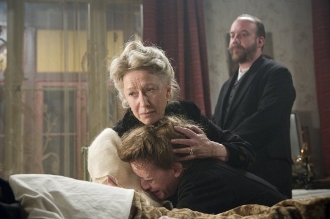 As the tension in the Tolstoy homestead mounts, Tolstoy decides to leave his home to die in peace. He hastily flees via train but, growing fatally ill, never makes it to his destination. Instead, he is forced to end his travels at the town of Apostovo where he spends his final days in a makeshift bedroom at the train station. In Apostovo, the narrative shifts focus from his legacy to an exploration of the impact of his death. Hoffman reminds us of what matters most in those final moments of life. Temporarily, no one is concerned with what will become of Tolstoy’s fortune, but is instead consumed by the imminent loss of their beloved. This, complimented by the two romances, fills the film with a lasting sense of love’s ability to help us endure the most challenging moments of our lives.
While the film is an intriguing tale of the trials of love, death, and legacy, it hardly references early 20th century Russia. Although the Russian Revolution was not until 1917, in 1910 at the time of Tolstoy’s death several competing populist organizations were speaking out against the autocratic rule of Nicholas II. In 1903, The Russian Social Democratic Labor Party split into the Bolsheviks, lead by Lenin, and the more moderate Mensheviks. Tolstoy was avidly against the czarist rule, but his beliefs ran contrary to those of Lenin, who believed that Tolstoy should keep his pen focused on art rather than politics.
Despite the sheer size of Russia and the possibility that the Tolstoyan commune could have existed relatively independent of the world around it, the numerous populist movements unfolding concurrently deserve a mention in The Last Station. If it were not for the periodic appearance of the Russian press, one might altogether forget that the film takes place in early 20th century Russia. The stalking press and constant articles detailing Tolstoy’s final days assert Tolstoy’s celebrity, but the film barely mentions War and Peace let alone his other literary works. The fact that we learn little about Tolstoy himself is not terribly troubling since the movie is really about his life post-novelist, however, his stature as Russia’s greatest author, which is integral to the message of the film, cannot fully resonate without the presence of Russia and the people themselves.
Overall, The Last Station is a story about the complicated role of love in our lives. Perhaps it is unfair to ask a film to be anything beyond a great story and The Last Station undoubtedly succeeds in that respect. But had Hoffman utilized the historical context readily at his disposal, it would have only strengthened the film and accentuated the fight over Tolstoy’s copyright—a fight that, at its heart, reflects the conflict between the community and the individual that was being fought all over Russia.
Related Articles from The Fanzine:
Brief Interviews with Hideous Men reviewed by Amy Meyerson
