When Disco Was the Soundtrack to Martial Law: David Byrne, Fatboy Slim and Imelda Marcos
04.05.10
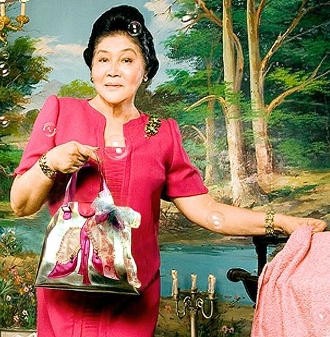 The more theatrical aspects of Imelda Marcos’s life, perfect for a telenovela, have become familiar material not just to Filipinos but to all those who have followed the ongoing drama of the woman whose penchant for unrepentant excess has given rise to the adjective “Imeldific.” Such a life has proven to be a rich source of fascination to writers and musician/composers, including David Byrne. Three years ago at Carnegie Hall, on a cold February night, he, along with a band and vocalists, performed a song cycle based on the life of La Imelda (or as she is known in more irreverent circles, La Maldita, a/k/a Bad Girl). That song cycle has now been expanded into a two-CD, 22-song set, titled Here Lies Love––words that presumably the eighty-year-old former beauty queen, first lady, and billionaire widow of the late unlamented Ferdinand Marcos, wishes to have inscribed on her tombstone. The set features a number of well-known vocalists, from Cyndi Lauper, Natalie Merchant, Santigold, Tori Amos, to Byrne himself.
I reviewed the Carnegie Hall gig for a Manila daily and, begging the reader’s indulgence, let me quote a bit from that review:
“But why would a well-known Scot-American rocker be drawn to Imelda? Byrne writes in the program that he was drawn by her ‘timeless story of power, politics, and psychological needs.’ He also notes that ‘this song cycle wants to evolve into something somewhat undefined, but surely more theatrical.’ The telling phrase here, to me, is ‘somewhat undefined,’ accurately encapsulating not so much the night’s musical performance but its content.”
That something is now a bit more clearly defined, but not by much. Leaving aside for the moment, any lack of examination of Imelda’s culpability in wrecking a country’s economy, her calloused behavior towards the brutalities regularly inflicted on the body politic, as well as in the creation of a multitude of bodies never to rise again, and her narcissism brought to new highs (or lows)—wouldn’t such scrutiny come under the rubric of psychological needs?—this is psychology lite, and much less filling than the music.
Indeed, you can’t go wrong if all you seek is the music, the intricate layers of beats that Fatboy Slim laid down to re-create the clubby, disco feel of the 1970s. Imelda watchers know that she loved disco, particularly as an arena where she could spin with the social and political elites in the U.S. The 1970s were also a time when the Marcoses were at the height of their power. “Dancing Together” (Sharon Jones on vocals) displays the arriviste’s ambivalent joy at the company she keeps on the dance floor, Warhol, Oleg Cassini, the Rockefellers, Margot Fonteyn and the Queen of Spain, among others. There are references to rocking with George—clearly, George Hamilton, a favorite Imelda celeb who returned the favor by testifying at Imelda’s federal trial in 1990, about how like a mother she was.
Byrne understandably steers clear of certain clichéd images that have come to mark the public persona of Imelda: the shoes, the bulletproof bras, the mania for shopping. He’s savvy enough to know that that leads down the well-worn path of cheap tricks and little insight. He also steers clear of a conventional narrative, instead zeroing in on the emotional moods. For Byrne, in his written introduction to the set, history can be “a series of collective moods and emotions as well” and that those “emotions are sometimes lost to us.”

Even given that emotional truth is what artists aim for primarily, if the sum of a real-life flesh-and-blood person who affected a whole country for two decades, is reduced to emotional moods, then Imelda comes off as nothing more than an extremely rich, insecure, eccentric melodramatic queen. What difference, say, between the emotional curve of a Leonora Helmsley and an Imelda Marcos? In Byrne’s style of telling, none. And that is a pity.
Sure, there are several songs built around Estrella Cumpas, the devoted maid and witness to the young Imelda’s genteel poverty who helped take care of her in her pre-glam days. With its Brazilian carnival layer, “Never So Big,” with Sia on vocals, is especially poignant, as Estrella recounts trying to get in touch with her former charge, now visiting their hometown as First Lady but who will not allow her siesta to be disturbed by an inconvenient reminder of a past she seeks to distance herself from. (Sleep was an excuse, of course; Imelda is one of those rare creatures who can get by on as little as two to three hours of snooze.) Their relationship would have been a perfect stand-in for the larger one, between a powerful woman (who not so long ago declared she owned the country), and the nation, whose sympathy and even, at the outset, its high regard, she once had but whose generosity and forbearance she regularly and mercilessly abused. It’s a great moment that could have been mined for its resonance as a powerful metaphor but alas, Byrne chooses not to.
This is rather puzzling. Imelda actively took part in governing the country, and had been named by Ferdinand as his successor in the event of his death. Wags always said that the country had His and Hers governments. It was this and her attendant notoriety that drew Bryne’s attention in the first place. Beyond superficial nods to political events such as the declaration of martial law (“Order 1081”) and the imprisonment of Senator Benigno “Ninoy” Aquino (“Seven Years”)–the Marcoses’ most celebrated political opponent, whose assassination in 1983 eventually led to the demise of the regime—there is no sense of the public and political context that shaped Imelda, a grievous omission that undercuts Here Lies Love’s attempt to investigate what as well as who made Imelda what she is.
More than a few glimpses of the dark side would have given these songs a complexity and a richness, that would have displayed the underbelly, the grit and steel and desire for dispensing comeuppance, of the li’l poor girl finally allowed to dance at the ball—a raven-tressed Cinderella, swept off her feet by Prince Charming and who found not only one but a multitude of shoes to walk in. In his desire to steer a course between tabloid images (Those shoes! Those jewels! George Hamilton!) and a portrait of a delusional woman indifferent to a nation she professed to love, Byrne ends up sidestepping the moral transgressions, and ambiguities, that mark Mrs. Marcos’s life then and now.
Love in her dotage is what Imelda craves most. She’s famous for going on and on about love (and its corollary, beauty, as well as energizing holes in the sky)–a sure sign she feels its absence acutely, likely the poisonous hangover of a painful childhood. Someone who genuinely loves her country, as Imelda keeps declaring, would never have acted the way she did and does. What I suspect Imelda truly adores, beyond her grandiose sense of self, is the notion of love. Real people, unfortunately, get in the way, as Estrella and a whole nation inevitably did. There’s the rub: For all its theatricality, Here Lies Love lacks the irony that could have given it a Brechtian edge.
____________________________________________________________
Editors’ Note: Special thanks to Carolina San Juan of the UCLA World Arts and Culture program for the title of this piece.
Related Articles from The Fanzine:
Knowing Me, Knowing You, Knowing Them: Louis Chude-Sokei on Representing the “Other”
