Repetition with Variation: The Sound of an Electronic Summer — Tobacco “Maniac Meat,” The Books “The Way Out,” Autechre “Move of Ten” and Matmos / So Percussion “Treasure State”
30.08.10
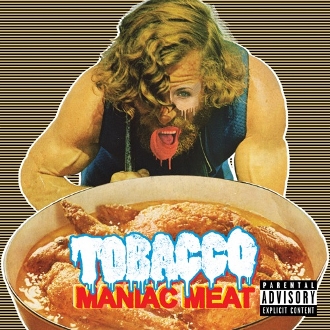 Any listener who counts Tobacco’s previous work as a solo artist or as a member of the rock band Black Moth Super Rainbow among those albums they particularly enjoy will in all likelihood experience one of those moments of pleased recognition from the opening few seconds of “Constellation Dirtbike Head,” the first track on his latest, Maniac Meat, – “Oh yes, I recognize this sound, I like this sound. I think I’ll enjoy this album.” Those first few seconds are all that are needed to firmly establish Tobacco’s aesthetic, his signature whirring synths and those smeared-out vocoder tones undergirded by dirt simple electronic beats announcing his unmistakable presence. From Black Moth Super Rainbow onwards, Tobacco (Tom Fec) has inarguably crafted a distinctive style, one that likely went a long way towards bringing him into relative popularity. He consistently relies on antique analog equipment to create a signature set of textures. The singularity of this style is, however, a bit of a double-edged sword, presenting Tobacco with the problem that endlessly plagues artists across genres when it comes time to produce a second album. At this late stage in the history of music criticism, this problem has become the go-to talking point for any sophomore release: how does the band adapt their sound? Is it a move towards current standards of accessibility, a burrowing into and “refining” of their established interests, or a case of branching out into new territories and genres?
Tobacco opts for all three items on that completely non-inclusive list. He burrows back into his characteristic grinding haze, while also enlisting the decidedly-mainstream-yet-demonstrably quirky Beck to lend vocals to a couple of tracks. Bringing another vocalist on board turns out to be a good decision. In much that same way that Aesop Rock’s turn on the final track of Tobacco’s previous album hoisted Tobacco’s sound into new and invigorating places, the introduction of a new kind of stylization and a cleaner, clearer vocal production provides a new perspective on the chugging synthetic fuzz. However, Beck doesn’t provide as strongly differentiated of a counterpoint as Aesop Rock did. Beck adds wrinkles to the style rather than a sharp kick to it, and as a result there’s never a clear reason offered as to why he shows up – the songs on which he guests mostly sound like Tobacco songs, plus Beck. Besides this high-profile guest, of course, there are a few other elements that set Maniac Meat apart from its predecessor, most of which can be summed up by noting that the overall aesthetic is considerably harsher, the buzzing, grinding elements are brought to the fore and the floating ethereal tones diluted or excised. But even with these tweaks, the album as a whole consistently generates the pleasure of recognition mixed with the frustration of stasis – those fluttering arpeggios and the skewed-worldview of his lyrics still excite for a moment, but over the course of an album they start to wear.
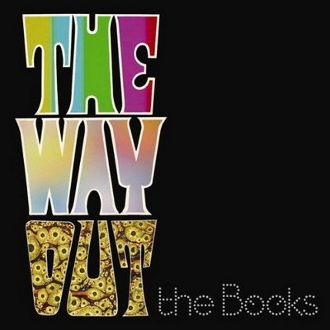
Would this feeling still occur if another Tobacco album didn’t exist, or if this particular reviewer hadn’t heard it? What is it about Tobacco’s continuation of his musical niche that causes it to grate over time? These questions can be extended to, though not in any way resolved by, the case of The Books’ most recent release, The Way Out. Like Tobacco, The Books are a duo with a sound that has become exceedingly well-defined by their previous output – in their case, a mix of cello, guitar, and other acoustic instrumentation chopped up and spliced back together along with a variety of samples and electronic manipulation. On their latest album, we find the group taking the route of making clear forays into new genres and sounds, integrating these new elements into their style, bringing in elements of funk, hip-hop, and folk balladry on various tracks. This branching out is done in a laid-back, playful manner, as evidenced by their tendency to utilize samples in an overtly humorous way. The opening track neatly introduces this approach, sampling a New Age relaxation tape letting listeners know that “On this recording, music specifically created for its pleasurable effects on your mind, body, and emotions, is mixed with a warm, orange-colored liquid.” Underpinned by inviting, shimmering bass tones, the sentiment is played both for the inherent amusement of the earnest announcers and semi-seriously – the album, as much or more so than their other albums, could, of course, serve pretty much the purpose described by these recontextualized therapeutic voices.
This relaxed, quietly self-effacing approach serves The Books well, though it does create an environment in which experiments such as “I Didn’t Know That” is left as more of a joke than a finished song. Despite a characteristic splice-job, the song’s white-boy TV-theme funk hews a little too close to the genres it borrows from. Elsewhere, however, we get lovely forays into balladry, showcasing the band moving into territory which slots in quite logically with their sound, while still offering interesting variations, as with “All You Need is a Wall” which shows up amiably with a woozy acoustic guitar-led sound and affectingly direct vocal melody. There are other high points besides these drowsy ballads – while this is perhaps the least rigorous-sounding Books album, its playfulness and open-mindedness never translates into a lack of energy, as it also sports some of the most directly beat-driven songs of their career, showcasing their ear for unusual sounds within an unusually driving context. What ties the whole thing together is the consistent methodology though which it is produced, bringing the methods and tonalities established in their previous works to bear on a wide variety of sounds, helping to smooth over the album’s occasional too-obvious moments – a few overly simplistic jokes such as the drawn-out frog/hip-hop pun of “The Story of Hip-Hop” and a couple of blunt genre signifiers, such as the hip-hop breaks on that same song. Within the context of The Books’ proven methods, such moments are less irksome than they could be, revealing unexpected pleasures. On the whole The Way Out is a pleasant exercise in opening up their sound while consistently maintaining its basic elements. Perhaps this is the distinction between the methods in which The Books and Tobacco hone their sounds – The Books have created a more open-ended model of musical construction which allows for the induction of a variety of sounds, while Tobacco’s style is more encompassing – he just hasn’t left a lot of room for himself to maneuver.
 Like both of these artists, Autechre are a group with such an immediately identifiable sound that each new release becomes an exercise in placing that sound within some form of a re-defined context. On their latest, the rather-long-for-an-EP Move of Ten, they focus on sharply punctuated points of rhythm in contrast to their more ambient full length Oversteps released earlier this year. Unlike The Books or Tobacco, any playful aspects of Autechre never come anywhere near the surface of their music. Despite their fondness for obscurantist song titles and a tendency to drastically upset the expectations of hip-hop or dance-floor techno, Move of Ten maintains an aggressively flat emotional profile. This is the sound of a group focusing directly on the specifics of musical construction over any sort of emotive interests. At this point in their long career, the appeal in a new Autechre album is now, more than ever, a question of the technical specifics – to what degree can they push the limits of the 4/4 environment? What novel arrangements of rigorously metrical pinpoints of cold electronics can be constructed? The interest here lies in careful attention to the ways in which Autechre stack and re-arrange their arppegiators and pinging electronics, and even if it requires a great deal of attentive listening, the payoff is still there. Their focus on meter on this release allows for something of a clear entrance point to the music, but ultimately Move of Ten functions only if the listener is willing to seek out the intricacies of individual pieces, which then reveal a fair level of depth, proving that Autechre still have an ear for unusual arrangements of rhythms and tonality, even if they’re no longer the sparkling-new-poster-children of forward-thinking-electronic-music. And they don’t need to be. This isn’t the sort of music that seizes the listener — its aggression is the aggression of unflinching rigor rather than the look-at-me directness of so much of contemporary electro-dance music. That statement isn’t a slight against either form – the bluntness of modern music is often an asset, as evidenced by the recent critical and commercial success of Brooklyn duo Sleigh Bells’ bombastic, overdriven sound – but Autechre offer an example at the other end.
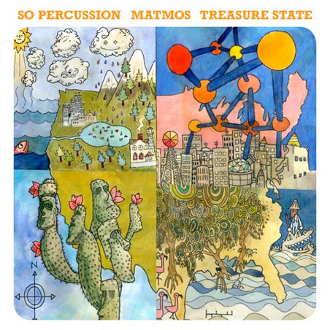
Equally uninterested in the more flamboyant elements of electronic music, Treasure State is a collaborative effort by So Percussion and Matmos. Like Autechre, both Matmos and So Percussion have spent their time crafting works built around strict conceptual limits – Matmos famously created two tracks on A Chance to Cut is a Chance to Cure exclusively from audio samples of operating rooms and the entire album adheres to this medical theme, while the Brooklyn-based percussion quartet has built projects around both trains and Italo Calvino’s Invisible Cities. As the meeting point between their two highly conceptual approaches Treasure State finds itself in a somewhat unusual context, as it, like The Way Out, relaxes and expands the sounds each group is known for. The result is an album in which concepts are still invoked but less stringently so, picked up and moved on from. The tone is at once breezy and experimentally minded, resulting in a collection of tunes that are as congenial as they are satisfying in intellectual and aesthetic terms. On “Needles” the band picks up the (excellent) conceit of writing a song utilizing nothing but samples of an amplified cactus, producing an intoxicating bit of modern minimalism bolstered by its charmingly playful instrumentation restriction, but the cactus ends up extending its reach beyond the intended conceptual boundary, popping up on a number of other tracks. One gets the impression that the band started out with the concept and then simply decided that the cactus was fun, and should be kept around.
Even the more “difficult” fare on Treasure State contains an element of this breezy conceptualism – while “Swamp” slots neatly into the category of live electro-acoustic improvisation, its literal-minded dedication to evoking a swamp lends it a certain inviting stubbornness. Plus, it also features the cactus. Elsewhere we find loose concepts played on beer cans and pieces of ceramics – “Aluminum” and “Shard”, respectively, but the album is tied together by a focus on traditionally “pleasant” melodies played on odd instruments or odd scales, resulting in a mix that falls somewhere between a campfire song-circle and a minimalist composition. It’s an unassuming album, but it’s one that plays to both groups’ strengths. Matmos and So Percussion have placed themselves at the intersections of a variety of musical and cultural contexts – academia, concept music, modern electronic, folk, and so forth – but on Treasure State this positioning is never brought to the fore. The focus, instead, is on the innate interest of unusual instrumentation applied to accomplished musicianship. Treasure State feels like an album made for its own sake, and that’s not a bad thing at all.
______________________________
Related Articles from The Fanzine:
Dutch cut’n’paste pop star Solex reviews her own Pandora Station
