Kay Ryan: The Best of It
02.03.10
 The Best of It
by Kay Ryan
Grove Press
288 p.
When Kay Ryan reads one of her poems in public, she reads it twice. They’re so short that if she didn’t, the audience may miss one entirely, by glancing out the window or concentrating too hard on Ryan’s voice. She also reads it twice for the joy of it. Several years ago, positioned in front of a wall of windows at Santa Rosa Junior College’s Mahoney Library, the view reminded her of this poem, so she read it:
Green Hills
Their green flanks
and swells are not
flesh in any sense
matching ours,
we tell ourselves.
Nor their green
breast nor their
green shoulder nor
the languor of their
rolling over.
Then she read it again. She is a careful and clear orator, but intends her poems to have enough cues in them so that any reader will hear the poems “inside the theatre of her own skull” just as she intends them. In the poem, it’s not the line breaks or the punctuation that guides the reader, but the cadence of the words themselves. The rhythm is established by the two unstressed syllables (“nor their” and “nor their”) followed by two stressed syllables (“green breast” and “green shoul-”). Then in the last lines, like an engine turning over, this rhythm is disrupted. The sounds themselves roll over each other, showing not just that the premise of the speaker—that the hills are not a body—is wrong, but proving it.
Then she laughs, or explains the spelling of a homophone (as in “Don’t Look Back,” which describes those who are “neckless,” like fish, not a necklace), or points out an embedded oronym (in “Turtle,” she uses the like-sounding phrases “a four-oared helmet” and “ill afford”). She will even describe the image she had in mind for the poem or where she was when she wrote it (usually in bed). Mostly her joy in writing poems comes from the rhymes and the assonance, which are both inevitable and surprising, and this joy is transferred to the reader as well. At readings, Ryan will call attention to a rhyme and comment, “I’m not sure I even knew it when I did it,” but be certain that the sound in one word suggested another, and that she realized the meaning later. Any poet versed in writing in form will recognize how generative self-imposed constraints can be. While her poems seem to be created from pure sound untarnished by understanding, they also feel true.
Most of Kay Ryan’s poems present an argument, which allows for the reader the gratification of mental exertion and the thrill of discovery. Each poem starts you in one place—often by reflecting on a common saying, such as “a drop in the bucket” or “the fabric of life”; dissecting a natural phenomenon; or scrutinizing a belief assumed to be universal (as in the often-quoted “Blandeur,” which pleads for grandeur to be suppressed/for less to happen)—and extends that metaphor or examination to its farthest possible conclusion. In the end you are looking at the subject from a completely different point of view, and you feel smart. You feel like you’re the one who figured it out—and with no effort! This is the pleasure of reading, and you’re grateful to the poet for it.
In “The Edges of Time,” for example, Ryan returns to some of her favorite subjects: the twin states of intention and procrastination, the physical nature of time, and in the last lines a bit of the bleak conservationism which discreetly accompanies many of her images from nature, while making a compact and lucid case and concluding with what feels like the spontaneous brilliancy of epiphany.
It is at the edges
that time thins.
Time which had been
dense and viscous
as amber suspending
intentions like bees
unseizes them. A
humming begins,
apparently coming
from stacks of
put-off things or
just in back. A
racket of claims now,
as time flattens. A
glittering fan of things
competing to happen,
brilliant and urgent
as fish when seas
retreat.
Ryan’s arguments and inquiries scrutinize, but they are not without the emotional honesty we expect from poetry. Even in her longing, her innate conservationism manifests—she wants things to stay. The poems plead for basic human comforts, such as stability, assurance, moderation, cleanliness, significance, wisdom, and release. As she puts it, “pleading for less, less heat, less stimulation, less company.” “Surfaces” reads: “Surfaces serve/their own purposes,/strive to remain/constant (all lives/want that).”
In her analysis of Robert Frost’s “Nothing Gold Can Stay,” Ryan attributes the poem’s “perfection” to its trickiness—the “involuntary ha!” that the poem elicits, as though “you’ve witnessed a wonderful magic trick.” The aspect she praises is much like her own work, but so is the aspect of the poem that is resigned—and not lamentably so—to decline. In Frost’s poem, “leaf subsides to leaf”; in Ryan’s poetry, she prays for change to be tempered, fever quelled. Ryan’s work is also compared to that of Emily Dickinson because both poets write compact, elliptical verse that explores ideas and theories through sound and image (and perhaps not coincidentally because both have a reputation for being reclusive women). In addition to these similarities, Dickinson often expresses a kindred longing: “The heart asks pleasure first/And then, excuse from pain—/…/And then, to go to sleep;/And then…/The liberty to die.”
What I value most, though, is Ryan’s great pity (for herself and everyone else). Without irony, she recognizes that life is hard and that it’s the daily struggles that make it hard—like procrastination or aging—without undermining those struggles or suggesting them insignificant. In “Spiderweb,” a poem with a simple but accurate metaphor, she takes a look at a seemingly small affair from the point of view of the person who’s in the middle of it, beginning, “From other/angles the/fibers look/fragile, but/not from the/spider’s…” The poem comes to the charitable conclusion: “It/isn’t ever/delicate/to live.” Applying the same sympathy to a more devastating circumstance, Ryan wrote “Things Shouldn’t Be So Hard” about the grief caused not just by the great terrible event of a death, but by every tiny terrible moment after.
A life should leave
deep tracks:
ruts where she
went out and back
to get the mail
or move the hose
around the yard;
where she used to
stand before the sink,
a worn-out place;
beneath her hand
the china knobs
rubbed down to
white pastilles;
the switch she
used to feel for
in the dark
almost erased.
Her things should
keep her marks.
The passage
of a life should show;
it should abrade.
And when life stops,
a certain space—
however small—
should be left scarred
by the grand and
damaging parade.
Things shouldn’t
be so hard.
Go ahead; read that one again. Ryan has likened her poems to empty suitcases full of scarves and tiny cars full of clowns: “I want my poems to not have very much in them, but when you start pulling, stuff just keeps coming out.” They bring immense satisfaction to multiple readings.
*
Currently, as the Library of Congress’s sixteenth Poet Laureate, Kay Ryan is working on her poet laureate project, which by design is intended “to raise the national consciousness to a greater appreciation of the reading and writing of poetry.” In Ryan’s case, Poetry for the Mind’s Joy is an initiative through which she hopes to draw national attention to community colleges, as well as drawing the colleges’ attention to poetry, an appropriate endeavor for a poet who has avoided creative writing workshops entirely but taught basic English skills at a public two-year college for over thirty years. Teaching has helped her writing, specifically, her “metaphor-making.” She explained in an interview, “One of the most essential things for all teachers is that you have to develop the ability to create analogies… you have got to move a student from a condition of not understanding something to understanding it, and you’ll use anything you can… their skateboard…”
According to its website, the project “highlights poetry being generated on community college campuses, as well as the vital role played by community colleges in nurturing lives and minds.” Advantageously revealed just a few months after Obama announced a $12 billion community-college initiative, it includes a community college poetry contest administered by the Community College Humanities Association and a video conference open to the public on April 1, 2010.
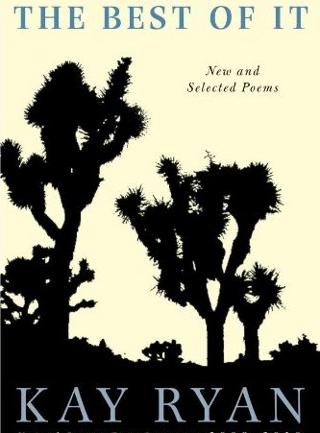
In the meantime, however, Ryan and her publisher are working to satisfy expectant readers and capitalize on what seems to be the most publicity a poet can get short of translating The Inferno or dying. Her newest release, The Best of It, is a selection of 206 poems from her last four full-length books, as well as 23 new ones (all of which have been previously published in Poetry, The New Yorker, The Paris Review, etc.), and one early poem, possibly her first (dated 1965).
To discuss Kay Ryan’s most recent book is to discuss her entire body of work, and not only because the new book consists of mostly older poems. I was told once by an art school instructor that the reason Kay Ryan isn’t taught in college is because “she doesn’t change.” Reading almost two decades worth of her poems between two covers will show you this isn’t entirely true, but rather that Ryan has been whetting her craft all these years, perfecting the type of poems that she wants to write. They are like hard little diamonds, each brilliant but cut only slightly differently. Emily Dickinson too had a unique poetic style which she utilized again and again, perfecting with what some would call limited variation were she not so universally admired.
The Best of It does not include any poems from Dragon Acts to Dragon Ends (1983), Ryan’s first book, which donations from friends helped her self-publish, or Strangely Marked Metal (1985). The volume does, however, remove the need to buy the first two books it collects. Only three poems from Flamingo Watching (1994) are not included here, and these three are not just relatively long but—dare I say—wordy. Just five poems from Elephant Rocks (1996) are omitted. What these eight discarded poems have in common is an overabundance of examples, which readers will not miss. Many more poems from her two most recent books, Say Uncle (2000) and The Niagara River (2005), are excluded, including some of her best work. I recommend buying these two volumes separately, even at the loss of The Best of It.
 Ryan’s greatest growth in poetic skill and in the clarification of her poetic intention occurred in the nine years between Strangely Marked Metal and Flamingo Watching, so The Best of It doesn’t offer the breadth to show the extent of it. Reading some of the poems reprinted from Flamingo Watching, however, does let you experience part of the fun and ease of the older poems, which is that there’s less in them. They’re less dense, less like tiny cars filled with clowns, less like hard little diamonds. They are more narrative; they inquisitively describe animals (there is more than one poem about bird watching); they have more words.
Ryan herself might laugh at how distinct and decided her style has become. Perhaps she already has, in one of the collection’s new poems, “Galápago,” (which may also comment on the lack of new poems for this volume):
As one reiterates
oneself day after day,
it’s not uncommon
to see nondominant
traits diminish
and the self stray
toward the cartoonish.
As though the self were
a straightening Galápago
where not everything was
going to stay affordable.
Say a stylized struggle
were currently underway
among the finches
whereby the few brighten
while the species vanishes.
Whether that was her intention or not, I don’t know. Ryan is no stranger to reverse-meaning-making. While she facetiously claims to never write about anything that actually happens (and to impatiently litter her poems with fake facts, fake animals, and fake science), she’s often discovered after writing a poem how uncannily it applies to events that hadn’t occurred yet, which she credits to clear writing. “Home to Roost” was sitting on the desk of The New Yorker’s poetry editor on September 11, 2001. It draws an image of the sky darkened by chickens circling before the sun, coming “home to roost.” And these aren’t just any chickens, they’re “the chickens/you let loose.” In this case, Ryan had to ask that the poem be returned and it was later published elsewhere. In others, reverse-meaning-making is a felicitous occurrence. “The Museum of False Starts” vaguely describes a “beautiful but/unfinished” gallery of vanishing thoughts and imagined gardens, and finally:
[…] caught
in the ancient ash,
the single spiraling
horn of an otherwise
unfashioned animal.
Ryan has of course conjured a unicorn, which she herself only later realized. Then she got to feel the wonder and thrill we feel when we read her poems.
*
These days, any poet would be unaccustomed to the publicity arising from being appointed the Poet Laureate, but more so Ryan, the self-described “modern hermit.” Kay Ryan’s reputation as a poet was slow to rise in literary circles, partially because when she was writing her first poems (the 1970s) confessional poetry was in and Ryan’s seemed comparatively (and disparagingly) abstract and impersonal. She reciprocated, put off by the self-importance, drama, and exposure that seemed to follow the grossly autobiographical poets of the day.
Some critics still suggest that “over time the author seems to be disappearing from [Ryan’s poems]. They seem to be growing more abstract; there’s less of a personal voice.” But insofar as the poems have become more and more stylistically unique, they have become more personal. They chronicle a particular mind’s inner life, and in a world often defined by identity politics and social networking, it’s refreshing to be given the opportunity to put the outer self aside. In “Impersonal,” an earlier poem, Ryan addresses this bluntly:
The working Kabbalist
resists the lure of
the personal. She
suspends interest
in the Biblical list
of interdicted shell fish,
say, in order to
read the text another way.
[…]
it might easily seem
comical, how she
ignores an obviously
erotic tale except for
every third word,
rising for her like braille
for something vivid
as only the impersonal
can be—a crescent
bright as the moon,
a glimpse of a symmetry,
a message so vast
in its passage that
she must be utterly open
to an alien idea of person.
In her more recent poems she does nearly abandon both the “I” and the “she” of the pseudo-character, and instead goes directly for the universal “we” of our shared experience. She says she doesn’t write about her own experiences; I think instead she is writing about all of our experiences—what any one of us might think had we considered the spider web or the green hills or our own “stacks of put-off things.” Again, her sympathy is generous, and her plea is not to but for all of us. This new anthology could have been named for its fifth poem: “We’re Building the Ship as We Sail It,” the title of which gives us a sense of the direction in which Ryan’s sensibilities are embarking.
Speaking of all of us, she writes, “We are alone, and poems make us more alone,” in her one-page introduction to Poem in Your Pocket (2009), an anthology of poems bound like a prescription pad or daily calendar. But she means it in the good way:
Alone in the sense of experiencing inside yourself a cascading series of exquisite discriminations and connections which leave you in the fullest possible possession of your self while simultaneously providing the most intimate escape from self…. And strangely enough, it is during the private murmured conversation between the poem and the reader, both agreeing that the world cannot be known or contacted, that it is.
______________________________________________________________________________________
Related Articles from The Fanzine:
Mean Free Path by Ben Lerner reviewed by Jeff Johnson
