HARDCORE UFOs PART II: 50 Years After Sputnik
04.10.07
 HARDCORE UFOs Pt II: 50 Years After Sputnik
by Michael Louie
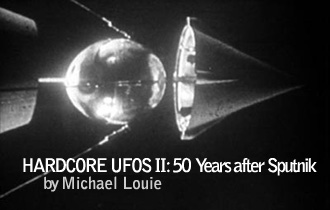
This day is the fiftieth anniversary of sending a tiny, fragile sphere into space. It’s important to remember that, amongst the 20/20 hindsight of just what Sputnik launched into the frontiers of military and civilian imaginations, it burned up and disintegrated ninety days later.
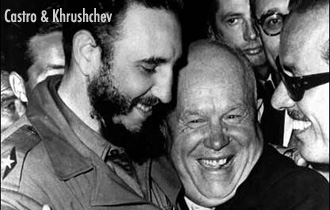
On October 5, 1957, Soviet newspapers dutifully reported the launch of Sputnik 1 in calm and clinical language. That morning’s edition of Pravda stated: “As a result of very intensive work by scientific research institutes and design bureaus the first artificial satellite in the world has been created. On October 4, 1957, this first satellite was successfully launched in the USSR [. . .] At the present time the satellite is describing elliptical trajectories around the Earth, and its flight can be observed in the rays of the rising and setting Sun with the aid of very simple optical instruments.” The Soviet premier, Nikita S. Khrushchev, informed of the launch by telephone while visiting the Ukraine, later wrote that he “congratulated the entire group of engineers and technicians on this outstanding achievement and calmly went to bed.”
The rest of the stunned world, namely Russia’s then-chief rival, the United States, matched the Soviets’ stoicism (a style now found in more commonly from news reports emanating from the Chinese government) with blasting banner headlines, all capitals and italics, heralding the achievement in terms that may have been more appropriate for one of their own. SOVIETS FIRE EARTH SATELLITE INTO SPACE; IT IS CIRCLING THE EARTH AT 18,000 M.P.H.; SPHERE TRACKED IN 4 CROSSING IN U.S. As the U.S. wondered aloud at the implications for the future of the Cold War, and that of man himself, reactions on the other side of the Pacific were almost nonchalant in their modesty. “[Sputnik’s launch] was seen as one more thing in Soviet technical progress, one more achievement,” Sergei N. Khrushchev, the premier’s son, said in an interview with the New York Times. “It was one more thing for us and we were proud, but it was a shock for the United States.”
It’s possible the younger Khrushchev’s perspective on such a monumental event was bred less out of (what was perceived) as Soviet arrogance during a mounting Cold War, and more out of allegience to the Soviet leadership’s own subdued reaction: perhaps the elder Khrushchev had not known exactly what his scientists had wrought. The premier was not even notified of Sputnik’s success until its second orbit around the Earth was over, nearly 200 minutes after the satellite was released into its ellipse. It wasn’t until Sputnik had garnered such international attention the following day that the Russian government decided to make headlines of their own. “We must make big noise about this,” Sergei recalled his father saying. “Yes, big noise.”
Russia got its propaganda machine rolling the next day, with Pravda’s belated headline, “World’s First Artificial Satellite of Earth Created in Soviet Nation.” The paper’s coverage ranged from maps of Sputnik’s orbital crossings above Russia and the United States to poetry dedicated to the satellite. What was missing was the who? of the journalistic equation: the parties responsible for Sputnik’s success were not named, instead cloaked under somewhat inelegant titles like Chief Designer of Rocket-Space Systems and Chief Theoretician of Cosmonautics, or simply not named at all. According to a report laboriously titled Soviet Space Programs, 1962-65; Goals and Purposes, Achievements, Plans, and International Implications, Prepared for the Committee on Aeronautical and Space Sciences, Premier KhrushchevKhrushchevKhrushchev promised that the scientists’ identities would be revealed in due time. But, “in order to ensure the country’s security and lives of these scientists, engineers, technicians, and other specialists, we cannot yet make known their names or publish their photographs.”
 The Soviet Union had plenty reasons for withholding the names of the men responsible (not to be overtly sexist here; but at this point nearly all research in the fields of missile development and weaponry was performed by men, and has since retained a prominent air of “machismo”): one, the Soviet Union was required to do so by the Politburo, and, regardless, traditionally kept it inner workings inscrutable to the West; two, the United States were in the midst of an ever chilling Cold War; and three, and most importantly, both states were actively testing nuclear weapons of increasing mass and destructive yield, as well as preparing missile defenses in the event of a nuclear war, like the Nike-Zeus program in the United States. Sputnik, the highly-polished aluminum sphere with a 23-inch diameter, weighing a slight 184 pounds, and hurling around the Earth at 18,000 miles per hour, completing an orbit every 96.17 minutes, beep-beep-beeping (hear a mp3 file of the Sputnik signal here) pushed the world’s imagination literally toward the heavens as a reality, and more than ushering in the final frontier of exploration, opened another door that seems to be the recurring theme of our galaxy: that of war and weaponry.
In Don DeLillo’s magnum opus Underworld, he describes a family, American as Jell-O molds, three days after the Sputnik announcement:
Erica felt a twisted sort of disappointment. It was theirs, not ours. It flew at an amazing rate of speed over the North Pole, beep beep beep, passing just above us, evidently, at certain times. She could not understand how this could happen. Were there other surprises coming, things we haven’t been told about? Did they have crispers and breezeways? It was not a simple matter, adjusting to the news.
Although the news of Sputnik’s flight came as a surprise for most of the world, the year in which it was launched was actually designated as a time for intense scientific study of the Earth’s outer atmosphere. In 1952, the International Council of Scientific Unions designated the solar year July 1, 1957 to December 31, 1958, as the International Geophysical Year. The May 1954 deadline for participation passed without Russia expressing any ambitions, and that fall, the United States announced its plan to launch an artificial satellite into space during the IGY. In an article titled “Korolev, Sputnik, and The International Geophysical Year,” NASA historian Asif A. Siddiqiwrites, “The satellite proposal clearly surprised the Soviet delegation, and perhaps had repercussions within the USSR Academy of Sciences. In the fall of 1954, the Academy established the Interdepartmental Commission for the Coordination and Control of Work in the Field of Organization and Accomplishment of Interplanetary Communications, a typically longwinded title which obscured its primary role, a forum for Soviet scientists to discuss space exploration in abstract terms, both in secret and in public.”
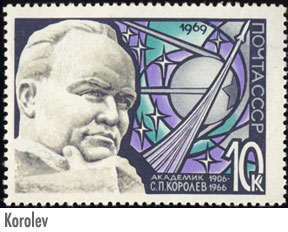
One of these scientists was Sergei Pavolovich Korolev. Born in 1906 and jailed by Stalin in 1938, Korolev had helped found a rocketry research group called GIRD (Gruppa Isutcheniya Reaktivnovo Dvisheniya, or Group for Investigation of Reactive Motion) in 1931, and while employed by the Russian military, which enveloped GIRD into its RNII (Reaction Propulsion Scientific Research Institute) began working with Mikhail Klavdiyevich Tikhonravov. Korolev directed the launch of Russia’s first rocket-propelled aircraft—one of Tikhonravov’s design—the RP-318, before being thrown into the Gulag, sentenced to the gold mines. Two years later, however, Korolev was assigned, by merit of one Sergei Topolev, a senior aircraft designer and former teacher of Korolev’s, to a sharashka—one of several secret design bureaus in place to exploit the incarcerated and develop new weapons for the war. Korolev was unsurprisingly assigned to Topolev’s sharashka, TsKB-39, working on bomber aircraft. In 1944, Korolev was released and cleared of all charges, spurious and otherwise.
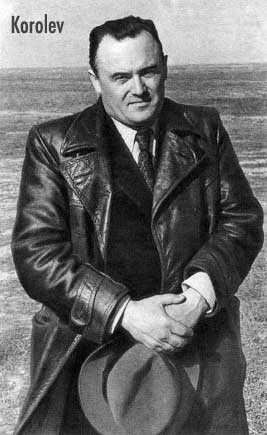 After the war, Korolev became chief designer at the head of Department No. 3 of the Specialized Design Bureau at the Scientific Research Institute No. 88, or NII-88 in its Russian abbreviation. NII-88 was charged with developing long-range ballistic missiles, though not yet the type that would escalate the nuclear war to the realm of nightmare misfires controlled by key from remote locations in mountain ranges. That happened on May 20, 1954, when Russian authorities assigned Korolev, now under the renamed Experimental Design Bureau No. 1 (aka OKB-1), to develop the first intercontinental ballistic missile, the R-7. Korolev hadn’t lost interest in space travel and the possibilities of launching artificial satellites; and at the same time he was assigned to the R-7, Mikhail Tikhonravov, who was working separately on application of ballistic missiles, released a paper titled “Report on an Artificial Satellite of the Earth.” Reception was lukewarm at best, but Korolev sent the report up the chain of Soviet command where it reached the hands of a defense leader, Georgiy M. Malenkov, whose interest was piqued by the potential military applications of satellites. Research into satellites was tacitly approved, but the focus remained on ICMBs, and the Sputnik to-be was put on an indefinite timetable.
As other top nations of the time prepared for the coming of the International Geophysical Year, Russia remained typically subdued and phlegmatic. But deep within the tissue of the Soviet government the wheels were turning. Then on July 29, 1955, President Eisenhower’s press secretary James Hagerty announced that the U.S. planned to orbit “small Earth-circling satellites” during the IGY. Three days later, Leonid Sedov, a Russian physicist and chairman of a Soviet group studying space exploration, told a group of reporters: “In my opinion, it will be possible to launch an artificial Earth satellite within the next two years. The realization of the Soviet project can be expected in the near future.” Although no specific plan for artificial satellites was approved, the hubris of Sedov’s response kicked Soviet authorities into another gear: Korolev’s dream was inching like a bumpercar in heavy traffic, yet undeniably forward.
“If earlier, Korolev’s satellite plans had been timed for the indefinite future, the Eisenhower Administrations announcement in July 1955 completely changed the direction of Korolev’s attack,” Siddiqi wrote. “Not only did it imbue Korolev’s satellite proposal with a new sense of urgency, but it also gave him a specific timetable to aim for. If the United States was planning to launch during the IGY, then the Soviets would launch one a few months before the beginning of the [IGY], guaranteeing a first place finish.”
Still, the Soviet government dragged its bureaucratic feet. Six months after the Eisenhower announcement, the USSR Council of Ministers finally issued a formal decree, obscurely referenced as 149-88ss, approving a satellite, called “Object D,” for launch in the IGY. “[T]he Soviet government probably viewed the satellite project in much the same manner as they viewed the continuing series of scientific rocket flights into the upper atmosphere which also used military missiles for ‘civilian’ purposes,” Siddiqi writes. “They were relatively inexpensive, unobtrusive, and ignored by the political leadership.”
By the fall of 1956, work on Object D was in serious crisis, due partially to the complex ambitions of the designers, and, more so, to government contractor apathy for the project. Korolev despaired, sensing the U.S. was working hard at getting their satellite ready in time for launch, while Russia was succeeding only in a proverbial wack-job. To make matters worse, he received a report that the U.S. had tried (and failed) that September to launch a satellite from a missile fired from Patrick Air Force Base in Cape Canaveral. The report was wrong—there was no attempt to launch a satellite along with the missile—but it made Korolev rethink Object D’s complicated design, to pare it down to something more simple and significantly lighter than the planned 1,400 kilograms. It also inspired Korolev with a renewed sense of urgency. He wrote Russian authorities in January 1957, noting the U.S. designs for its own satellite:
 “The most well-known project under the name ‘Vanguard’ uses a three-stage missile… In September 1956, the USA attempted to launch a three-stage missile with a satellite… which was kept secret… the payload flew about 3,000 miles….[U.S. media] emphasized that U.S. rockets can fly higher and farther than all rockets in the world, including Soviet rockets… it is known that the USA is preparing… to launch an artificial Earth satellite and is willing to pay any price to achieve this priority.”
Of course, ICBM development was also Korolev’s responsibility, and if American missiles could indeed fly higher and farther than Soviet rockets, then his department was the one to blame. His satellite’s launch was contingent on R-7’s success, not only as a technical vehicle, but as a political one as well—he’d assured premier Khrushchev himself that his satellite project would not hinder R-7 development. But, while designing the renamed Simple Satellite No. 1 (PS-1), Korolev witnessed three historic failures of his R-7 ICBM during the months of May to July 1957. Plans to launch a satellite before the IGY were obviously scrapped. Then in August, the fourth R-7 launch from Tyura-Tam flew 6,500km, and reached the target area over Kamchatka. This was a great success for Korolev, who, according to Siddiqi, “was so subsumed by euphoria that he stayed awake until three in the morning speaking to his deputies and aides about the great possibilities that had opened up, the future, and mostly about his artificial satellite.”
The military applications, macho posturing, and psychological intimidation this success afforded were not lost on Soviet authorities, who released a statement through their official news agency the following day: “The results obtained show that there is the possibility of launching missiles into any region of the globe. The solution of the problem of creating [ICBMs] will make it possible to reach remote regions without resorting to strategic aviation, which at the present time is vulnerable to modern means of anti-aircraft defense.”
To which, the rest of the world yawned. But an article titled “Spacemen are from Mars,” from the September 29, 2007 issue of The Economist, illuminates the real fears the R-7 launch had produced in the rest of the world, particularly the West. “Before Soviet engineers built the rockets that put Sputnik into orbit, warfare was seen as being, in some sense, a limited thing. Even in the atomic decade that had preceded the space age, bombers flown by real people would have to deliver nuclear death to their targets. Negotiations could take place while they were in the air. They could be shot down. And those that got through would probably not destroy everything. After Sputnik, mega-death would arrive in minutes by rocket, non-negotiably…”
Meanwhile, construction on PS-1 continued in fits and starts, before finally settling on what came to be known as Sputnik 1. The satellite comprised two spheres of aluminum alloy, capped with a highly polished thermal shield. Its innards were pressurized with nitrogen, and a drop in pressure could be indicative of a meteor strike. Two radio transmitters operating at 20.005 and 40.002 megahertz were placed inside, the sources of the famous (or haunting, depending on which side you were on) “beep-beep-beeping” which could be picked by ham radios. The transmitters were powered by three silver-zinc batteries, and ventilation fan was installed to keep them from overheating. On the outside, four antennae hinged on the surface of the thermal shield, all the better to hear the distinctive beeping as the tiny satellite zipped by––sometimes invisibly, sometimes glinting, in the last or first reaches of the sun––but audibly, obstinately, present in all of its shiny metallic smallness.
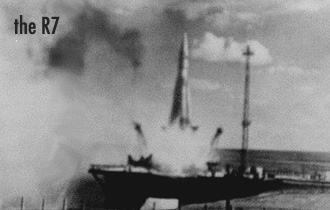 Nighttime, October 4, 1957, a modified R-7 ICBM sat on the launchpad at Tyura-Tam, flooded by artificial light. The R-7 was outfitted with a specialized nozzle system to ensure the separation of the satellite, nestled at the core of the missile, from the booster section. With senior members of the State Commission for the PS-1 launch in attendance, Korolev, nervous and as meticulous as ever, paced and repeatedly examined readings from various instruments, all the while watching for shifts in the crew’s collective and individual body language, nuances in the air indicative of some miscalculation, mishap, or malfunction. There were none.
As Siddiqi describes: “At exactly 2228 hours and 34 seconds Moscow Time, on 4 October, the engines ignited and the 272,830 kilogram booster lifted off the pad in a blaze of light and smoke…. Although the rocket lifted off gracefully, there were problems. Delays in the firing of several engines almost resulted in a launch abort. Additionally, at T+16 [where T=0 and time is calculated forward to launch and after, i.e. T-10 seconds to launch etc.] seconds, the System for the Simultaneous Emptying of the Tanks (SOBIS) failed, which resulted in higher than normal kerosene consumption. A turbine failure due to this resulted in main engine cut-off one second prior to the planned moment. Separation from the core stage, however, occurred successfully at T+324.5 seconds, and the 83.6 kilogram PS-1 successfully flew into a free-fall elliptical trajectory.”
Great success for Korolev, but he remained cautious. As the soon-to-be-familiar beeps were picked up over the Kamchatka target area, Korolev held out that they could still be mistaken. They weren’t. After the second full orbit, the State Commission Chairman telephoned Premier Khrushchev.
What happened next is, of course, well documented. While opening the doors for such successful projects like Apollo and Voyager, moon landings, and not so successful ones like Reagan’s inglorious “Star Wars” project, the matter of the fate of the Earth inevitably turned downward––toward ways of utilizing space to defend countries while devising ways to destroy others––as the rest of the world’s collective gaze focused upward. The possibilities for nuclear annihilation from afar were now very real, and engineers on both sides of the Iron Curtain rushed to find new ways to exploit, and defend from, space. That ambition is still alive. As the New York Times reported, the Bush Administration is requesting $11 billion of next years budget to test antimissile systems, including funding for something called a Space Test Bed, projected to cost $300 million. There still exists the desire to colonize our Moon and Mars, in perhaps fulfillment of the Biblical prophecy that the meek will inherit the Earth once the rich and powerful are finished abusing it. But on this day, the fiftieth anniversary of sending a tiny, fragile sphere into space it’s important to remember that, amongst the 20/20 hindsight of just what Sputnik launched into the frontiers of military and civilian imaginations, it burned up and disintegrated ninety days later.
